agumbe.dev
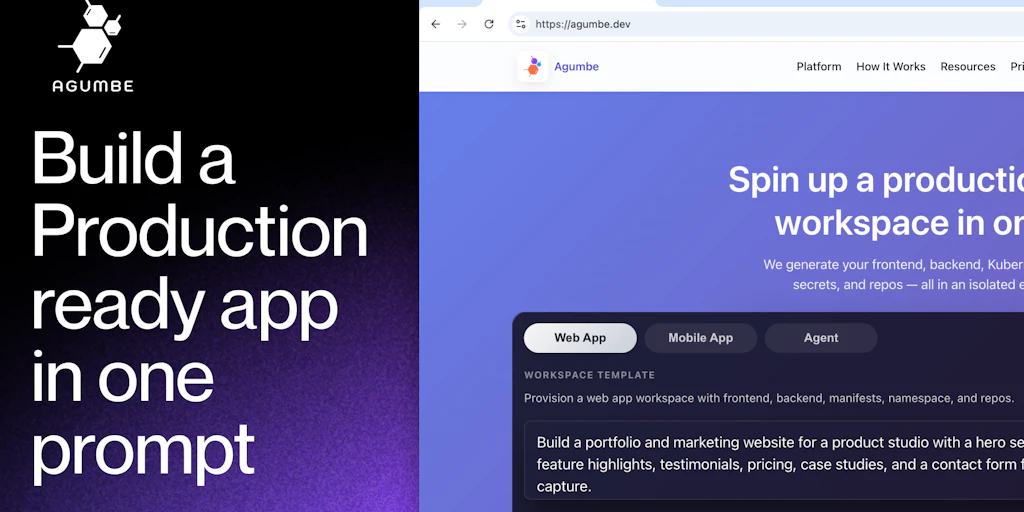
Foto: Product Hunt AI
The era of manually configuring hundreds of YAML files and struggling with distributed infrastructure is coming to an end thanks to agumbe.dev – a new platform that elevates the Kubernetes application building process into the dimension of AI workspaces. Instead of laboriously connecting ten different tools, developers receive an integrated environment that automates the journey from a raw idea to final production. The system is based on isolated workspaces, a native GitOps approach, and advanced artificial intelligence support for code generation and safe diff management. For the global creator community, this marks an entry into the "vibe coding" trend, where the technical complexities of the cloud are hidden beneath an intuitive interface. Agumbe.dev provides ready-made blueprints, built-in CI/CD mechanisms, secrets management, and full observability in one place. The practical result of implementing this solution is a drastic reduction in deployment time and the elimination of configuration errors that previously bottlenecked engineering teams. This signals that container orchestration is ceasing to be the exclusive domain of specialized DevOps engineers, becoming an accessible tool for every programmer wishing to quickly scale their products in the cloud. Infrastructure automation is becoming as fluid as writing code with an AI assistant.
The era in which developers spent long hours manually configuring YAML manifests and fighting the complexities of Kubernetes clusters is slowly becoming a thing of the past. Enter agumbe.dev, a platform promising a radical simplification of the application lifecycle through the use of artificial intelligence. Instead of laboriously stitching together ten different tools, developers receive an integrated workspace that takes the "from idea to production" concept to a whole new level of speed and security.
This isn't just another simple code generator. Agumbe positions itself as a complete ecosystem of AI workspaces, dedicated to building and running applications directly on Kubernetes. In an era of the growing popularity of the trend known as Vibe coding, this tool becomes the missing link between rapid prototyping and professional cloud deployment, eliminating the infrastructure chaos that often kills innovation in larger teams.
Architecture without diagrams and YAML spam
The traditional approach to cloud infrastructure usually begins with complicated diagrams and hundreds of lines of configuration code. Developers often get lost in so-called "YAML sprawl"—the uncontrolled growth of configuration files that become difficult to maintain. Agumbe.dev reverses this paradigm. Instead of forcing the user to manually define every network element or volume, the platform offers Workspace-based isolation. The structure is logical and transparent: projects are divided into environments, which in turn are divided into specific applications.
Read also


A key differentiator here is the GitOps-native approach. All Kubernetes deployments are powered by modern Continuous Delivery (CD) tools, ensuring that the cluster state is always synchronized with the repository. For engineering teams, this means an end to "manual hotfixes" in production that aren't reflected in the documentation. The system ensures consistency, allowing developers to focus on business logic rather than software delivery mechanics.
AI-powered application evolution
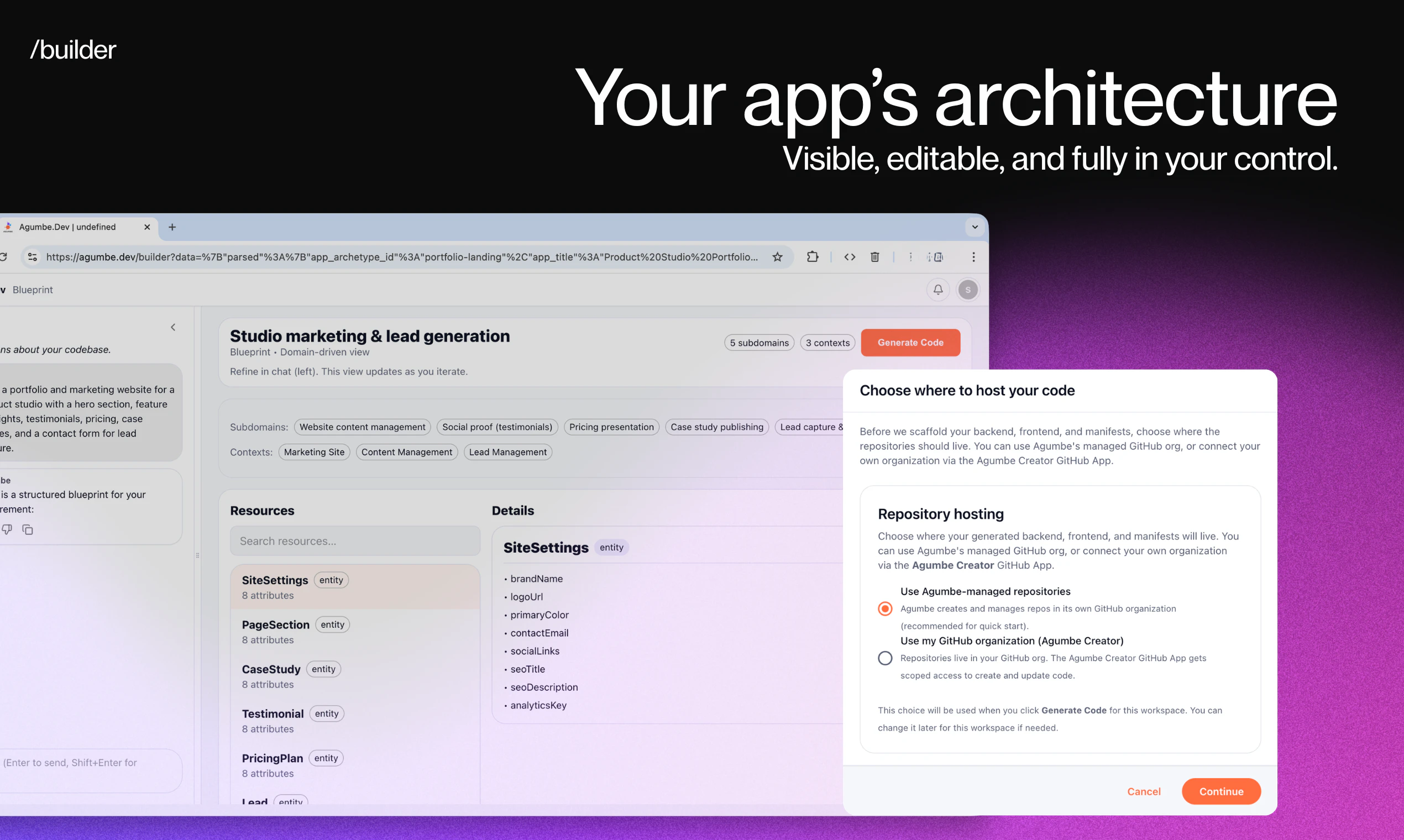
At the heart of agumbe.dev lies artificial intelligence that goes beyond mere syntax suggestions. The AI-assisted app evolution feature includes advanced blueprint generation mechanisms, automatic code creation (codegen), and—crucially for production environments—safe diffs. Thanks to secure change comparisons, a developer can precisely verify what the AI proposes to modify in the infrastructure before the changes are actually applied.
- Blueprints: Intelligent templates that automatically adjust the architecture to the application's needs.
- Codegen: Generation of ready-to-use code snippets and configurations, drastically reducing setup time.
- Safe Diffs: Visualization of AI-generated changes, ensuring full control over the deployment process.
- Built-in Observability: Integrated tools for monitoring application health without the need to install external agents.
The platform also provides built-in secrets management mechanisms and a full CI/CD stack. This means the team doesn't have to waste time integrating external systems for storing passwords or building container images. Everything is available "out of the box," which is becoming the standard expected by the most efficient teams in the world of Developer Tools.
Vibe coding enters the engineering mainstream
Observing trends on Product Hunt, where agumbe.dev made its debut, there is a clear shift toward tools supporting Vibe coding. This is an approach where the barrier to entry for high-level technologies (such as Kubernetes) is lowered to the level of intuitive interaction with an AI model. However, unlike many "no-code" toys, Agumbe targets professional engineers who need the robustness of cloud clusters but want to avoid the operational overhead.
Agumbe helps teams move from idea to production-ready applications without having to stitch together ten different tools.
It is worth noting the market context—platforms like Replit, Bolt.new, and Lovable are changing the way we think about code editors. Agumbe.dev goes a step further, bringing this revolution into the sphere of AI Infrastructure Tools. It is no longer enough to just write code with the help of AI; it also needs to be securely deployed, scaled, and monitored. This is exactly where Agumbe finds its niche, offering full control over environments with minimal manual effort.
A new standard for technical teams
Analyzing the capabilities of agumbe.dev, it's hard not to feel that we are looking at the future of Cloud Computing Platforms. Traditional consoles from cloud giants are often too complicated for rapid iterations, and simple PaaS (Platform as a Service) platforms are too restrictive. The proposal from the creators of Agumbe is the middle ground: the flexibility and power of Kubernetes combined with the simplicity of AI-driven operation.
For modern organizations that want to maintain the pace of innovation without expanding DevOps departments to monstrous sizes, such tools will become indispensable. Automating repetitive configuration tasks and providing intelligent support for application evolution is the only way to keep up with the growing complexity of distributed systems. Agumbe.dev proves that Kubernetes doesn't have to be "hard"—it just needs to be better managed through intelligent abstraction layers.
It can be predicted that in the coming months, we will see a surge of similar solutions; however, it is those that best integrate GitOps with generative artificial intelligence that will win the battle for developer attention. Agumbe.dev, starting with a strong emphasis on change security and environment isolation, has a huge chance to become the foundation for a new wave of applications built in the AI-native paradigm.
More from Tech


Related Articles

After court loss, RFK Jr. gives himself more power over CDC vaccine panel
Apr 6
Steven Spielberg Still Wants to Make a Horror Film ‘Someday’
Apr 6New Jersey has no right to ban Kalshi's prediction market, US appeals court rules
Apr 6