Context.dev
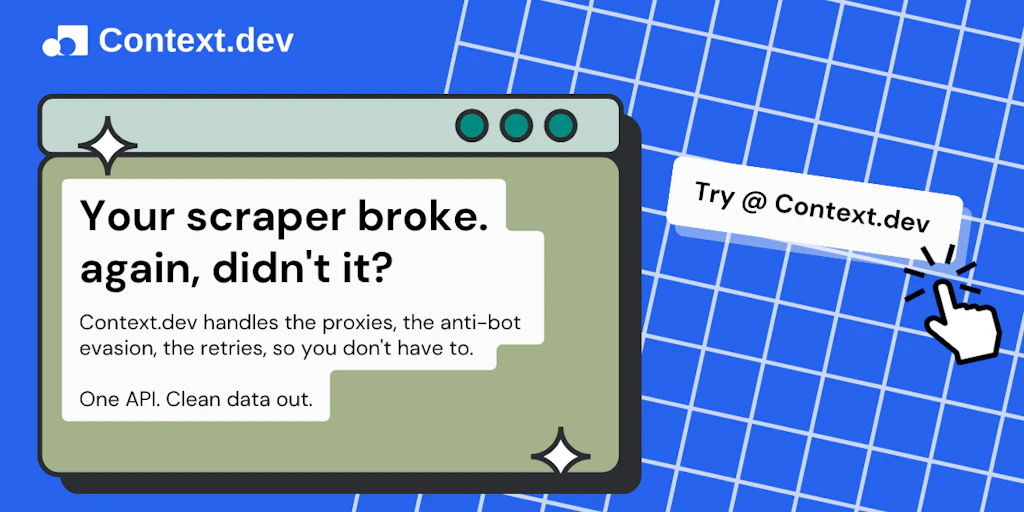
Foto: Product Hunt AI
More than 5,000 companies, including players such as Mintlify and Daily.dev, have already entrusted their data acquisition processes to the Context.dev platform, which has just officially debuted as a unified API for reading web resources. The tool, formerly known as Brand.dev, solves one of the biggest problems in modern development: unstable scraping infrastructure that requires constant repairs when source site code changes. Context.dev allows developers to transform any URL into clean Markdown or HTML, which is crucial for the efficient training of LLM models and powering AI agents. The system goes beyond simple text retrieval—it automatically extracts brand visual identities, including logos, color codes, fonts, and social media links. Thanks to dedicated SDKs for TypeScript, Python, and Ruby, integration of the entire ecosystem typically takes less than 10 minutes. For users and app developers, this means an end to the struggle with bot blocks or parsing unstructured code. The tool effectively democratizes access to structured web knowledge, enabling the construction of advanced search engines and shopping assistants that operate on real-time data without infrastructure delays. Utilizing a standardized API instead of custom scripts drastically reduces the maintenance costs of products based on external data.
In the era of generative artificial intelligence, data has become the new oil, but its extraction still resembles working in a 19th-century mine. Developers building AI agents and advanced LLM (Large Language Models) applications waste hundreds of hours fighting fragile scraping infrastructure, bypassing bot blocks, and cleaning chaotic HTML code. Context.dev, which has just debuted on the market (formerly known as Brand.dev), is challenging this status quo by offering a single, unified API to fetch, enrich, and understand web content in real-time.
This is not just another simple web parser. We are dealing with a comprehensive data engine designed with the modern AI tech stack in mind. Instead of building their own queue systems and proxy rotation mechanisms, developers receive a ready-made tool that transforms any URL into a structured, clean Markdown or HTML format, ready for immediate processing by models such as GPT-4 or Claude 3.5 Sonnet. The scale of operation is impressive – the solution is already trusted by over 5,000 companies, including recognized technology brands like Mintlify or Daily.dev.
An end to fragile scraping and manual parsing
The biggest pain point of systems based on web data is their unpredictability. A change to a single CSS selector on a target page can paralyze critical business processes. Context.dev solves this problem by abstracting the data retrieval layer. The API automatically manages JavaScript rendering, solves CAPTCHA challenges, and rotates IP addresses, delivering a final, "denoised" product to the developer. As a result, AI agents can operate on facts rather than parsing errors.
Read also


The platform goes beyond simple text copying by offering advanced data enrichment features. The system can automatically extract a brand's visual identity from any domain – from logos and color palettes to used fonts and social media profile links. This is crucial for brand intelligence tools and marketing automation platforms that must instantly adapt to a client's aesthetics without manual research.
Architecture built for speed and precision
Implementing new technology in large organizations often takes months, but the creators of Context.dev claim that most teams integrate their API in less than 10 minutes. This is possible thanks to native, typed SDK libraries for the most popular programming languages in the AI ecosystem:
- TypeScript – for modern web applications and Node.js environments.
- Python – the standard in data science and integrations with LangChain or LlamaIndex.
- Ruby – for fast deployments in startup ecosystems.
A key functionality that sets Context.dev apart from the competition is its ability to crawl sitemaps and resolve transaction descriptors. The latter is particularly important for the Fintech sector – the API can transform an enigmatic string of characters from a bank statement into a legible company name and its profile data. This shows that the tool is not only aimed at chatbot creators, but at the broad market of data analytics and ERP systems.
Data as fuel for autonomous agents
"The real bottleneck of AI is no longer computing power, but access to fresh, reliable data from outside the training set."
Modern language models suffer from hallucinations when they lack "here and now" context. Context.dev acts as an external cerebral cortex for AI agents, providing them with eyes and ears directed at the live internet. The ability to download data in Markdown format is a strategic choice here – LLMs handle this format much better than raw HTML, which translates into lower token consumption and higher response precision.
Analyzing the development direction of such tools, there is a clear trend toward service consolidation. Developers no longer want to use five different providers for proxies, headless browsers, and metadata extraction. They want a single point of access that guarantees high availability (SLA) and scalability. Context.dev, after rebranding from Brand.dev, clearly positions itself as the foundation for the Agentic Web – a future where software independently browses the web to perform complex user tasks.
A new standard in the Data-as-a-Service ecosystem
The data extraction tool market is saturated, but most players still focus on the technical "dirty work," leaving data interpretation to the user. Context.dev changes the paradigm: the API not only delivers data but helps to understand it. Integration with business processes such as contractor verification, automatic CRM profile filling, or competitor monitoring becomes trivial when the system itself recognizes the page structure and extracts its essence.
My prediction is clear: within the next 24 months, we will witness a massive shift away from proprietary scraping scripts toward unified interfaces like Context.dev. The AI arms race will be won by those who deliver high-quality contextual data to models the fastest, not those who are best at tricking anti-bot algorithms. Context.dev is becoming the missing link in this value chain, offering stability where previously there was only the chaos of fragile selectors and endless changes in the DOM structure.
More from Tech



Related Articles

After court loss, RFK Jr. gives himself more power over CDC vaccine panel
Apr 6
Steven Spielberg Still Wants to Make a Horror Film ‘Someday’
Apr 6New Jersey has no right to ban Kalshi's prediction market, US appeals court rules
Apr 6