Do you want to build a robot snowman?

David Paul Morris/Bloomberg / Getty Images
Nvidia has ceased to be merely a chip manufacturer, becoming the foundation of a new industrial revolution, as emphatically demonstrated by Jensen Huang’s presentation during the GTC conference. The unveiled Blackwell architecture offers up to 2.5 times higher performance in training LLM models while simultaneously drastically reducing energy consumption, making it a key infrastructure component for tech giants. However, it is Project GR00T—a general-purpose foundation model for humanoid robots—that is capturing the attention of the creative and technological industries. Thanks to it, machines can learn based on observations of human movements, significantly accelerating the development of utility robotics. For the global community of creators and engineers, this signifies the democratization of access to advanced automation. The integration of the Isaac platform with the Nvidia Omniverse ecosystem allows for the testing of complex designs in digital twins before they enter the physical world. The practical result of these changes will be a shortened production cycle and the ability to create intelligent assistants capable of working in unpredictable environments. Nvidia is not only providing computing power but is defining the standards where the boundary between software and the physical presence of AI begins to blur. The investment in the Blackwell ecosystem is a clear signal that the future of AI is not limited to text generation but is moving directly into the sphere of interaction with matter.
When Jensen Huang took the stage at this year's GTC (GPU Technology Conference), the tech world held its breath, expecting the next iteration of silicon. However, what we received goes far beyond a simple roadmap update for graphics processors. The head of Nvidia not only presented the world's most powerful chip but, above all, outlined a vision of a reality where the boundary between digital code and physical matter finally ceases to exist. This is the moment when the Santa Clara company officially stopped being a component manufacturer and became the architect of a global operating system for artificial intelligence.
The centerpiece of the announcements was the Blackwell architecture, named after the mathematician David Blackwell. The new B200 processor is a performance monster, equipped with 208 billion transistors, which allows it to achieve up to 20 petaflops of computing power in FP4 format. Compared to the previous Hopper generation, Blackwell offers a 5-fold increase in performance for LLM (Large Language Models) training tasks and a staggering 30-fold leap in inference processes. This is not an evolution — it is a brutal shift of the capability slider toward a direction that just a year ago seemed like pure science fiction.
From chatbots to physical presence
The most intriguing element of Huang's speech, however, was not the figures regarding HBM3e memory bandwidth, but Project GR00T. This is a foundational multimodal model designed specifically for humanoid robots, intended to serve as the "brain" for a new generation of machines. Nvidia wants robots to learn by observing human movements and interacting in a virtual environment before being released into the real world. Thanks to the Isaac Robotics platform, developers receive a complete ecosystem for simulating, training, and deploying autonomous agents that can understand natural language and mimic complex manual activities.
Read also
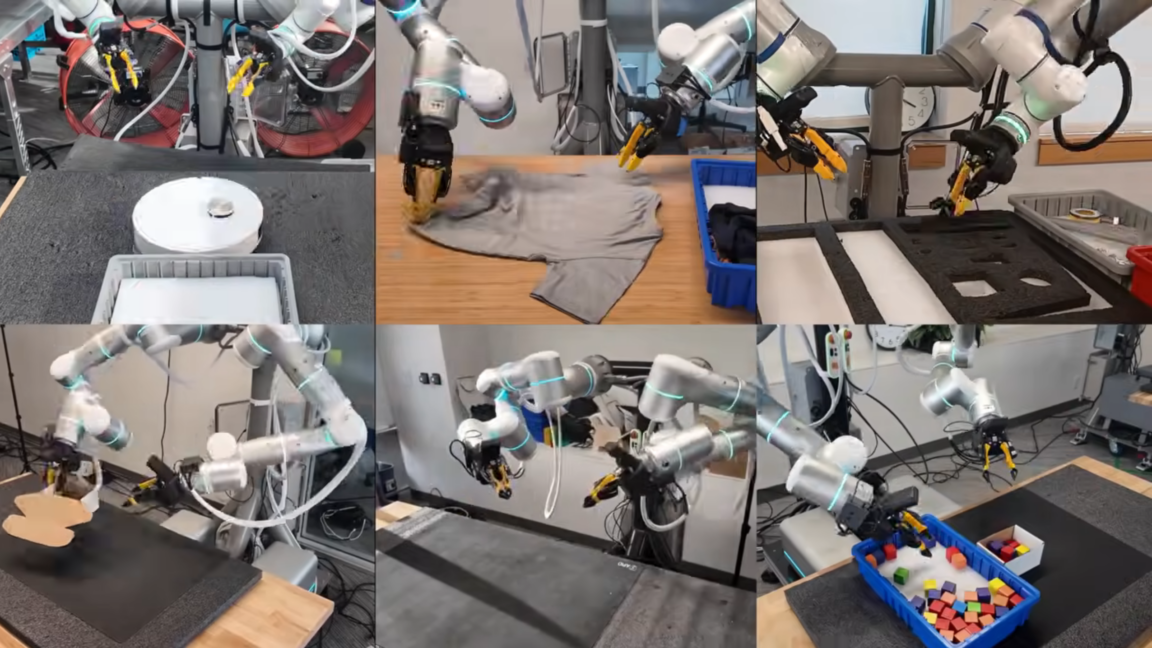

The introduction of GR00T changes the game in the robotics sector because it solves the so-called "sim-to-real gap." Machines trained in the Omniverse digital twin can undergo millions of hours of training in a few days, testing scenarios that would be too costly or dangerous in the physical world. Here are the key pillars of Nvidia's new robotics strategy:
- Jetson Thor: A new onboard computer for robots, capable of performing 800 trillion operations per second.
- Isaac Lab: An environment for reinforcement learning on a massive scale.
- Generative AI for Robotics: Models allowing robots to dynamically plan tasks without rigid programming of every movement path.
An ecosystem instead of a box of electronics
Nvidia is building a moat around its business with surgical precision, which the competition cannot jump over with better hardware alone. The key is Nvidia Inference Microservices (NIM) — a new way of delivering AI software that allows companies to instantly deploy models such as Llama 3 or Mistral in containers optimized for the manufacturer's infrastructure. Instead of spending weeks configuring the environment, engineers can run ready-made microservices, which effectively makes Nvidia a provider of a complete technological stack, from the transistor to the API interface.
This approach makes Nvidia the new Microsoft of the AI era. While other players, such as Intel or AMD, are still chasing H100 benchmarks, Jensen Huang is shifting the discussion toward AI Foundry. This is a business model where Nvidia not only sells shovels for gold mining but manages the entire mine, refining, and logistics of the ore. Companies are no longer just buying GPUs; they are buying access to a closed, perfectly oiled ecosystem, from which exit becomes more difficult and less profitable every day.
In the new industrial revolution, electricity is not the most important resource, but computational intelligence generated on demand. Blackwell is the engine of this change, and robotics is its ultimate test.
AI Factories as new critical infrastructure
The vision of "AI Factories" promoted by Huang redefines the concept of a data center. These are no longer rows of servers storing files, but active production centers where raw data enters from one side and ready, monetized intelligence comes out the other. Thanks to the new GB200 NVL72 systems, which connect 72 GPUs into one giant logical unit using NVLink, Nvidia has created a computer that treats an entire server rack like a single chip. This solution drastically reduces latency and energy consumption, which is critical in an era where electricity costs are becoming the main brake on the development of artificial intelligence.
Analyzing these moves, it is clear that the company's ambitions reach far beyond the technology sector. Nvidia is targeting heavy industry, logistics, and healthcare. Through partnerships with giants like Siemens or BYD, Omniverse technology is becoming the standard in designing the factories of the future. The ability to simulate entire production lines, taking into account the laws of physics, lighting, and interaction with GR00T robots, means that design errors can be eliminated in the digital phase, saving billions of dollars in reality.
Foundations for a new definition of work
Instead of asking whether robots will replace humans, Nvidia asks how quickly we can build the infrastructure so that these robots can start collaborating with us. The scale of investment in the Blackwell architecture and the Isaac platform suggests that we are on the verge of a "Cambrian explosion" in robotics. These will no longer be just mechanical arms bolted to the floor in a car factory, but autonomous systems capable of navigating an unstructured office or home environment. The limitation is no longer computing power, but our ability to integrate these systems with existing social structures.
My prediction is clear: within the next 24 months, Nvidia will stop being perceived as a "graphics card" company and gain the status of a provider of civilization infrastructure. The dominance of Blackwell in data centers and the monopoly on physical simulation software will mean that any company wanting to have a physical presence supported by AI will have to pay an "intelligence tax" to Huang's ecosystem. We are no longer just building robots; we are building a new layer of reality where code becomes as tangible as steel and concrete.