Domscribe
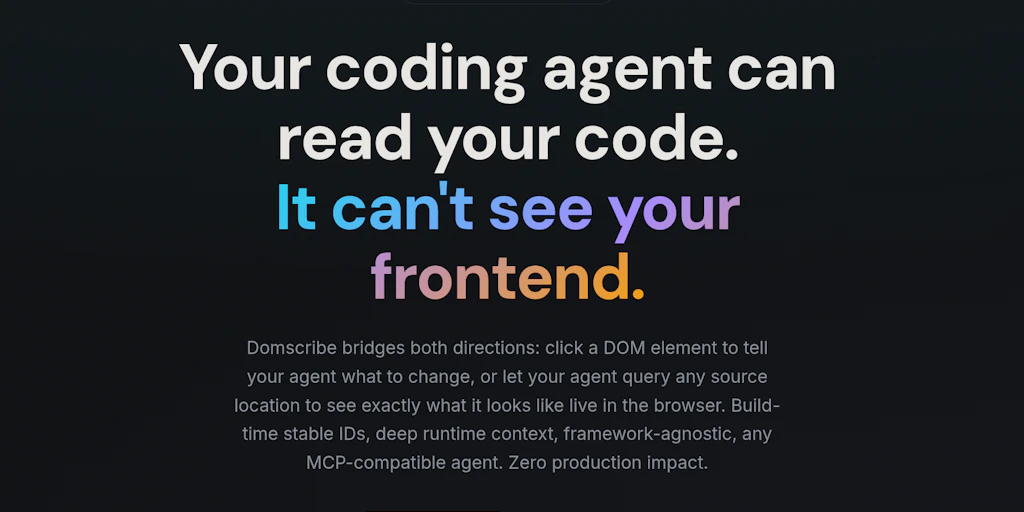
Foto: Product Hunt AI
Most AI agents program "blindly," editing files without a real preview of how changes affect the live user interface. Domscribe changes this dynamic by introducing the MCP (Model Context Protocol), which gives artificial intelligence direct insight into the rendered frontend. Instead of relying on inaccurate screenshots or guesswork, the tool provides LLMs with precise data regarding the DOM structure, passed props, and the current state of the application in real-time. For developers, this means an end to the tedious mapping of visual bugs to specific lines of code. Thanks to the UI → Code feature, one can simply click any element on the screen and describe the desired change in natural language; Domscribe then automatically points the agent to the exact location in the source file (file:line:col). The solution supports the most popular technologies, such as React, Vue, Next.js, and Vite, while maintaining zero impact on production performance thanks to stable identifiers generated during the project build. This is a milestone toward autonomous programming, where AI ceases to be just a text generator and becomes an operator aware of the visual context of the software being created. Domscribe, released under the MIT license, effectively closes the feedback loop between code and interface, eliminating errors resulting from a lack of synchronization between these two layers.
The modern software engineering landscape has been dominated by AI agents such as GitHub Copilot, Cursor, or Claude Engineer. Although these tools can instantly generate thousands of lines of code, for years they have struggled with the same fundamental limitation: they are "blind" to the final result of their work. An agent sees text files, but has no idea how a rendered React component behaves in the browser, whether a button overlaps text, or what the actual state of the application is at the moment of an error. Domscribe, a new open-source tool that has just debuted on the market, intends to change this by giving LLM models direct insight into the running frontend.
No more editing code "in the dark"
The traditional workflow with an AI agent relies on guessing. The developer describes a bug, the agent analyzes the source files and proposes a fix, hoping it hit the right spot in the DOM structure. Domscribe eliminates this uncertainty by introducing two-way communication between the code and the user interface. The tool utilizes the Model Context Protocol (MCP) to enable AI agents to query any source location and receive in return a live DOM tree, passed props, and the current state of the application.
This approach differs drastically from simply sending screenshots to multimodal models. While a screenshot only provides a visual representation, Domscribe provides structural data. The agent doesn't have to guess which component is responsible for a given element on the screen – it simply knows. Thanks to build-time integration, the tool generates stable identifiers that allow for precise linking of a rendered element to a specific file and line of code.
Read also



MCP technology and universal compatibility
At the heart of Domscribe is the use of MCP (Model Context Protocol), which makes it an extremely flexible solution ready to work with almost any modern coding agent. Instead of building a closed ecosystem, the creators focused on openness and broad support for the most popular frameworks and build tools. Domscribe works seamlessly with:
- Frameworks: React, Vue, Next.js, and Nuxt.
- Bundlers: Vite, Webpack, and Turbopack.
- Any AI agent supporting LLM Developer Tools standards.
Importantly from a performance and security perspective, the tool has zero impact on the production environment. All the magic happens in development mode, providing necessary metadata only when it is needed for working on the code. Thanks to the MIT license, this solution is available to a wide community of developers who can freely modify and adapt it to their own needs.
From a click in the UI to a fix in the code
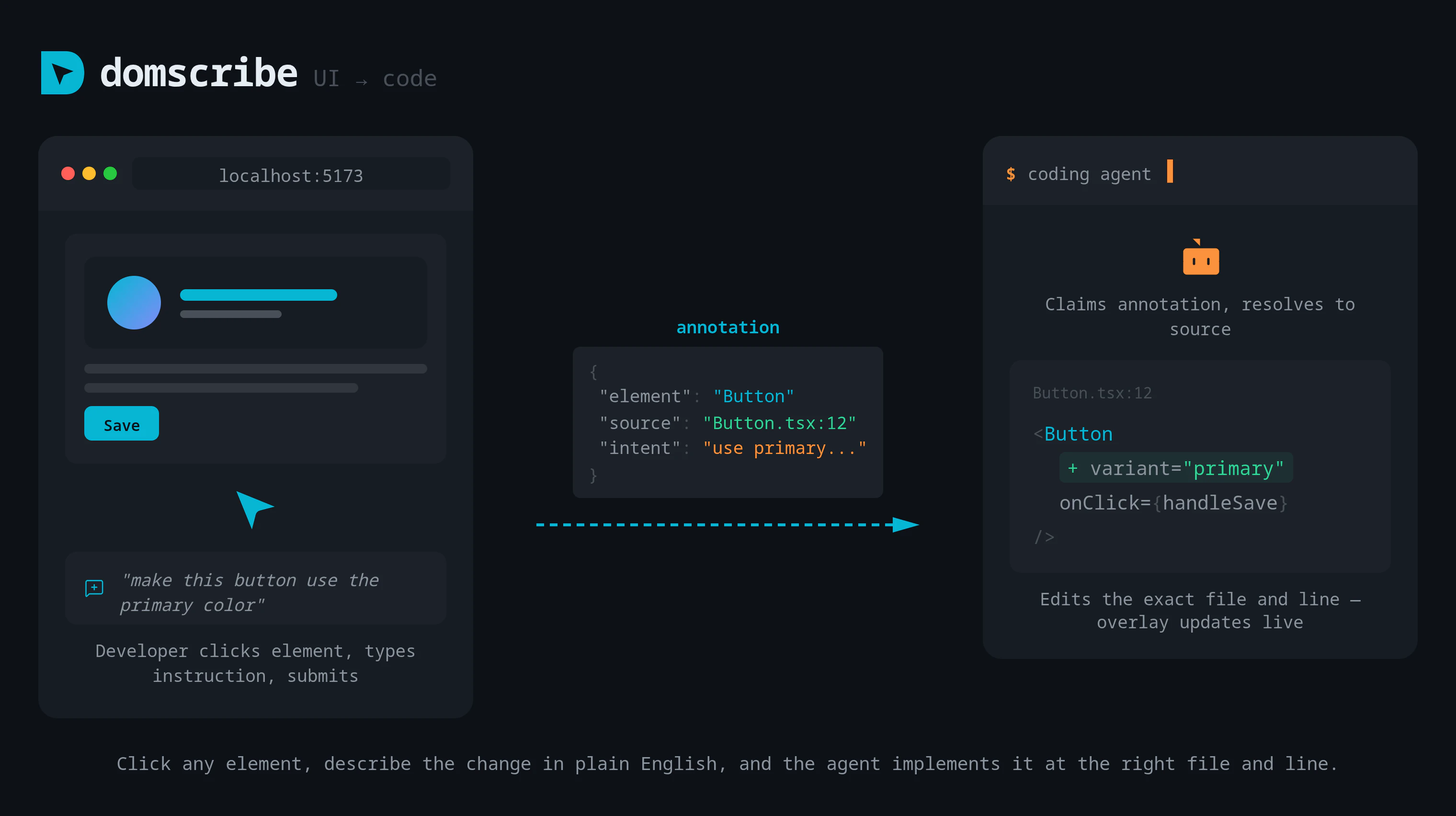
One of the most impressive features of Domscribe is the "UI → Code" mechanism. It allows a developer to click any element in a running application and describe the desired effect in natural language. For example: "change the color of this button to a darker one and add 20px padding." At this point, Domscribe performs a mapping operation, pointing the AI agent to the exact location (file, line, column) in the source code. The agent doesn't search through the entire project – it lands directly in the place that requires editing.
The use of stable build-time IDs solves one of the biggest problems of "inspect element" type tools – the volatility and unpredictability of dynamically generated classes (e.g., by CSS-in-JS). This allows the AI agent to work on a stable foundation, minimizing the risk of introducing errors in other parts of the application. This transition from guessing to precision engineering makes the frontend iteration process orders of magnitude faster.
"Domscribe fills the gap between the code editor and the browser. It is the bridge that was missing for AI agents to become full partners in the frontend development process, rather than just text assistants."
A new standard in LLM Developer Tools
The emergence of Domscribe signals a broader trend in the AI Coding Agents industry. We are moving past the excitement of just being able to generate code and starting to focus on context and precision. Tools that can "understand" the state of a running application will become the standard, replacing solutions that operate solely on static text analysis. For developers, this means less frustration when debugging complex UI states and the ability to focus on architecture instead of tedious localization of appropriate components in a maze of directories.
Introducing Domscribe into the daily tech stack could be a turning point for teams working in dynamic environments like Next.js or Nuxt. The ability to ask an agent for the "live DOM" and receive a precise answer about the state of props in real-time is functionality that was previously reserved for manual inspection in browser DevTools. Automating this process through Domscribe opens the way for fully autonomous agents capable of independently fixing visual and logical bugs in the frontend.
In a world where time-to-market is key, Domscribe offers an advantage that cannot be ignored. It is not just another wrapper for the OpenAI API, but a solid engineering tool that solves a real communication problem between human-AI-code. Developers who adopt this approach early will gain a powerful ally in the fight against technical debt and the complexity of modern user interfaces.
More from Tech


Related Articles

After court loss, RFK Jr. gives himself more power over CDC vaccine panel
Apr 6
Steven Spielberg Still Wants to Make a Horror Film ‘Someday’
Apr 6New Jersey has no right to ban Kalshi's prediction market, US appeals court rules
Apr 6