The concept of causality, in which event A must precede event B, ceases to apply in the quantum world, as confirmed by the latest research from a team at the University of Vienna. Scientists have proven that it is possible to create a quantum superposition of two different sequences of events, making what happened first merely a matter of probability. Utilizing a mathematical framework similar to the famous Bell inequalities, the researchers demonstrated the existence of a so-called "indefinite causal order," while eliminating the influence of hidden physical variables.
In practice, this means that a particle can experience two alternative timelines simultaneously—undergoing processes in the order A-B and B-A at the same moment. Although the experiment relied on entangled photons and the manipulation of their polarization, its implications extend far beyond optical laboratories. Understanding and formalizing the lack of rigid causality paves the way for designing entirely new architectures in Quantum Computing, where algorithms can operate outside the linear passage of time. For the global creative and computing technology sectors, this signifies breaking through processing barriers that have previously limited the efficiency of information processing systems, redefining the foundations of logic upon which we build future digital tools. The superposition of temporal orders is ceasing to be a theoretical singularity and is becoming a measurable technological resource.
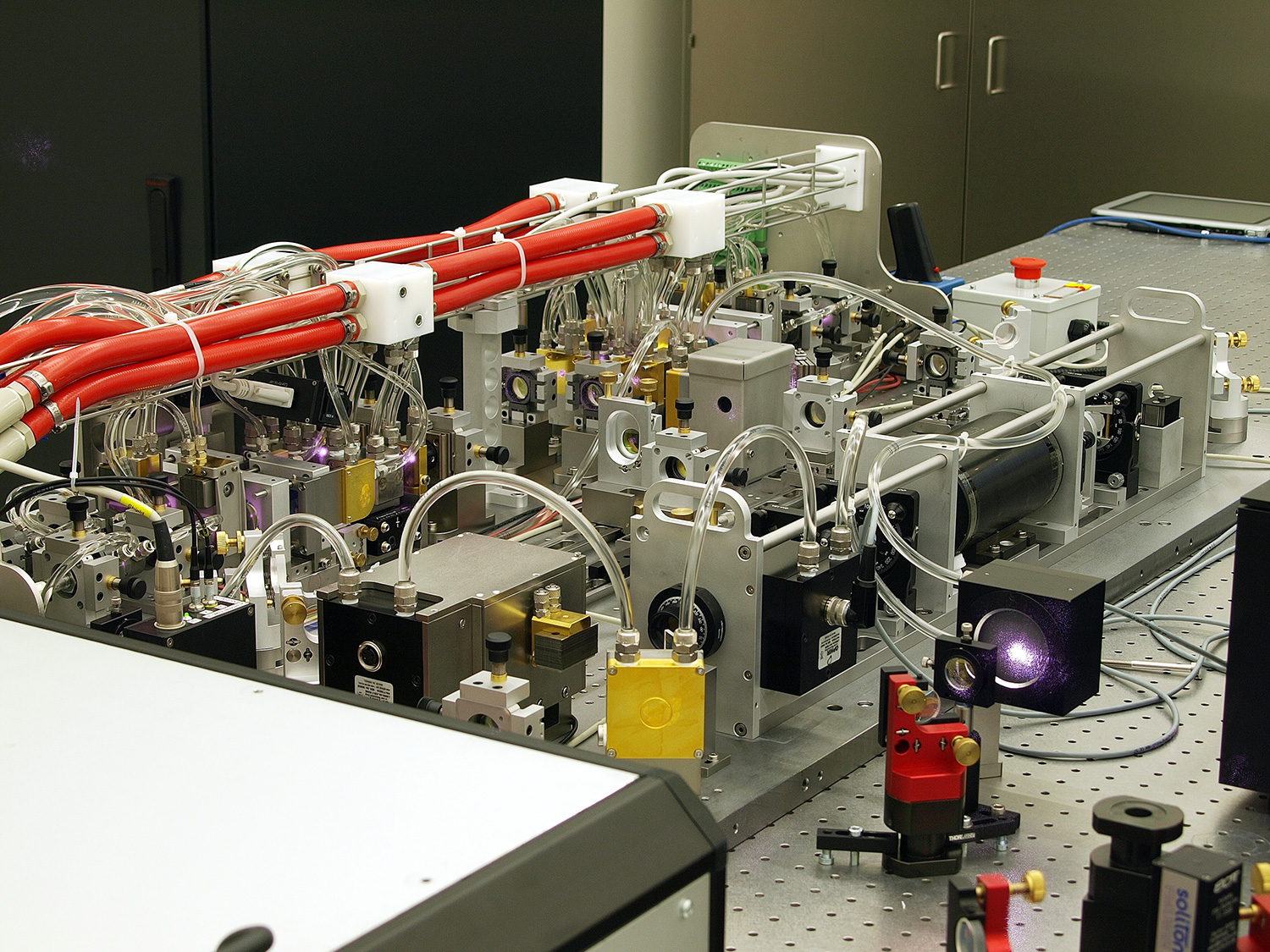
Advanced optical systems allow for precise manipulation of entangled photons to study the boundaries of causality.
## The Mechanism of Quantum Confusion
The foundation of this research is the phenomenon of entanglement and wave-particle duality. A decade ago, experiments already showed that measuring one of a pair of entangled photons could "force" a specific behavior (as a particle or a wave) on the other, even if the decision appeared to be made after the fact. This suggested that the measurement somehow travels back in time to determine the state of a photon that has already completed its path. This challenged the classical causal structure in which the past is immutable.
However, the Vienna team went a step further. Instead of studying individual cases, the scientists decided to check whether an indefinite causal order is a fundamental feature of reality. They used the concept of **Bell's inequality**, which in quantum physics serves to distinguish truly quantum phenomena from effects resulting from so-called local hidden variables. If the experimental results exceed a certain statistical threshold, we can exclude with certainty that some unknown classical mechanism is responsible for the strange behavior of the particles.
## Mathematical Proof of the Lack of Chronology
The experiment involved sending entangled photons through a device in which one of them was subjected to two manipulations: A and B. The key element was the polarization of the photon, which determined the path. Depending on the quantum state, the photon could pass through the system in the order A-B or B-A. By creating a quantum equivalent of the Bell test for causal order, the researchers were able to measure the correlations between the results.
The results proved devastating for proponents of classical order:
The obtained data deviated by 18 standard deviations from predictions based on the classical Bell's theorem.
It was demonstrated that the superposition of temporal orders is measurable and repeatable.
The experiment confirmed that the polarization of the second photon allows for the precise determination of the "temporal mixture" the first one was in.
Measurement precision on the order of 18 standard deviations almost completely excludes randomness in the results regarding the lack of causality.
Despite such strong evidence, the authors of the publication maintain scientific integrity by pointing out existing loopholes. One of them is the fact that approximately 99% of photons are lost during the process—only 1% reach the detectors. Theoretically, there is a marginal chance that these lost particles carry information that could restore the classical interpretation of causality. Additionally, the distances between hardware components were not large enough to completely exclude the influence of signals traveling at sub-light speeds.
## From Theory to Practical Benefits
Although the debate over the nature of time may seem purely academic, the physicists from Vienna emphasize that **indefinite causal order** has tangible applications in technology. Devices utilizing a lack of strict order of events can outperform classical processes in many fields. It is not just a matter of philosophy, but of computational efficiency and data transmission security.
Among the potential applications of this technology, the authors list:
Quantum Key Distribution (QKD): increasing the security of cryptographic communication.
Quantum Metrology: achieving measurement precision unattainable for standard devices.
Noise Mitigation: more effective operation in noisy communication environments.
Communication Complexity: reduction of resources needed to transmit information between network nodes.
The ability to be "wrong" about time turns out to be a powerful tool. If we can process information in a state where it is not limited by sequentiality, we open the door to a new class of algorithms and thermodynamic protocols. The history of research on entanglement teaches us that loopholes in experiments are closed over time. When this happens in the case of causal order, we will finally have to accept that at the heart of reality, "before" and "after" are just a matter of probability. Quantum mechanics proves once again that the deeper we look, the less stable the foundations of our everyday experience seem. Giving up rigid causality is the price we must pay for access to the full potential of quantum technologies.