Iris
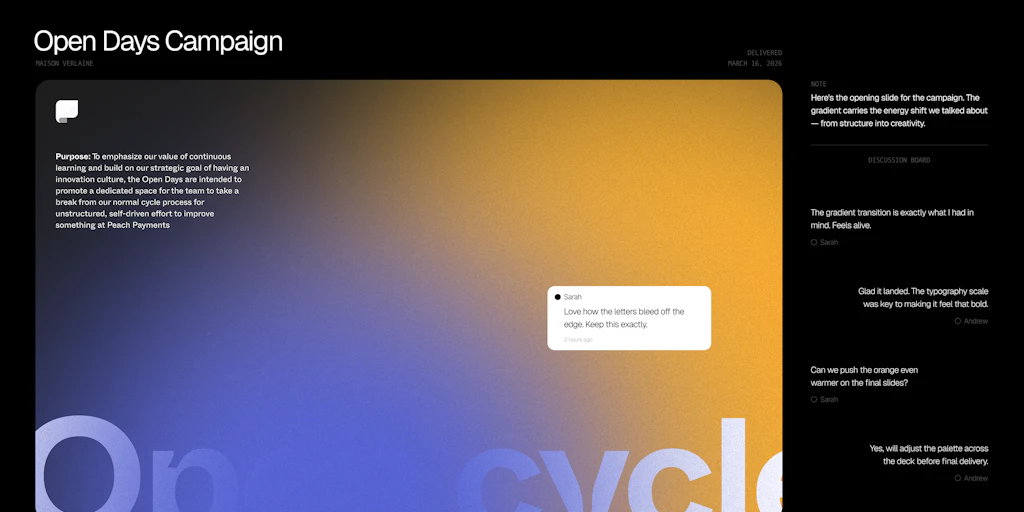
Foto: Product Hunt AI
As much as 80% of success in the creative industry depends on how we present the final result of our work, and the new Iris platform aims to completely eliminate the chaos associated with sending files and gathering revisions. The tool, which is just debuting on the market, transforms static presentations into a cinematic, full-screen experience accessible via a single link, without the need for the client to log in or download heavy attachments. Iris allows projects to be displayed as interactive slides, documents, or galleries, introducing a "pinned feedback" feature that ensures comments land precisely in specific areas of the design. For freelancers and agencies, however, the AI-powered analytics module will prove key. The system not only tracks which elements of the presentation captured the recipient's attention and which were skipped, but also generates a report interpreting this data after each session. This allows creators to understand the client's intentions even before the official meeting, drastically shortening the approval process and eliminating guesswork. In the era of remote work, Iris becomes the digital equivalent of a professional conference room, where it is not just the content that matters, but above all, flawless visual execution and data on recipient behavior. This marks the end of the era of vague emails with lists of corrections, replaced by precise communication embedded directly within the visual context.
In a world dominated by generic PDF attachments and chaotic email threads, the creative industry has long struggled with the "last mile" problem – the moment a finished project reaches the client. Iris enters the market with a clear mission: to transform a static presentation into an interactive cinematic experience that eliminates friction between creator and recipient. This is not another Google Slides or Canva clone, but a specialized client delivery ecosystem that prioritizes aesthetics and ruthless user behavior analytics.
The key problem Iris solves is the lack of control over how a client perceives our work after clicking "send." Traditional tools offer no insight into whether the recipient actually reviewed key slides or perhaps only skimmed the document, focusing on irrelevant details. Iris changes this paradigm by offering a cinematic full-screen experience that works instantly in the browser, without the need for the client to log in or install additional software.
Feedback precision instead of guesswork
The biggest pain point for designers and art directors is descriptive feedback, which is often vague ("let's change something in that bottom corner"). Iris introduces a pinned feedback system, allowing clients to leave comments directly on the visual elements of the project. Each note is pinned to a specific point in the space of a slide, document, or gallery, which drastically shortens the time needed to interpret revisions and eliminates the risk of communication errors.
Read also


This system works in real-time, creating a fluid layer of communication overlaid on the creative layer. Because Iris supports various formats – from classic slide decks to extensive image galleries – the tool becomes a universal hub for freelancers and agencies. Simplifying the process to a single, active link means the barrier to entry for the client practically does not exist, which is an invaluable asset in a professional workflow.
- Zero friction: No requirement for the client to create an account increases the chance of a quick response.
- Contextual comments: Comments pinned to specific pixels eliminate email chaos.
- Multi-format support: Handling slides, documents, and galleries in one interface.
- Cinematic delivery: Full-screen presentation emphasizing the visual quality of the work.
Analytics that read the client's mind
What sets Iris apart from the competition is deep session analytics that go beyond a simple file-open notification. The platform monitors how much time the client spent on each slide, which sections they skipped, and which ones they returned to repeatedly. This kind of data is priceless during negotiations or creative concept presentations – allowing the creator to prepare for specific questions or objections before they are even formulated by the client.
Furthermore, Iris uses algorithms to interpret the collected data. After the client ends their session, the system generates a report that translates raw numbers into concrete conclusions. If a client spent five minutes on a pricing slide but skipped the strategy section, the creator receives a clear signal of where the flashpoint lies. This data-driven creativity approach allows for much better business relationship management and builds expert authority.
"Iris doesn't just show that a client opened the link – it tells you what intrigued them and what bored them before you even get on a call."
A new standard for professional presentation
The modern creative services market is becoming increasingly saturated, and winning a pitch often depends not just on the quality of the work itself, but on how it is served. Iris targets the high-end freelance and premium agency segment, where the professionalism of communication tools is an extension of the creator's personal brand. The ability to send work as an elegant, cinematic experience builds a completely different collaboration dynamic than sending a link to a Dropbox or Google Drive folder.
It is worth noting the technological aspect of the platform – its lightweight operation in the browser while maintaining high fidelity in color reproduction and detail. In the era of remote work and asynchronous communication, tools like Iris become an essential link in the production chain. The platform proves that productivity tools for the creative industry must evolve toward greater transparency and a better understanding of client psychology.
- Session Insights: Tracking recipient attention in real-time.
- Automated interpretation: A system suggesting the meaning of client behaviors.
- Professional branding: Presentation that builds the contractor's prestige.
- Asynchronous flow: Perfect alignment with modern work models.
The end of the static attachment era
The appearance of Iris on Product Hunt is a signal of a broader trend: moving away from passive content delivery methods toward active engagement-monitoring platforms. In an AI world where content generation is becoming easier, the way it is curated and presented will define a specialist's market value. Iris gives creators a tool to defend their vision through data, showing in black and white which project elements actually resonate with the recipient.
It can be expected that in the near future, the features offered by Iris will become a standard that larger platforms will have to strive for. However, it is precisely the agility and focus on a specific niche – creative professionals – that gives Iris an advantage at the start. This tool redefines the concept of "project approval," turning it from a one-sided decision into a process based on measurable interactions. In a world where attention is the most valuable currency, Iris provides a precise meter of its expenditure, which becomes a powerful business argument in the hands of a skilled project manager.
More from Tech


Related Articles

After court loss, RFK Jr. gives himself more power over CDC vaccine panel
Apr 6
Steven Spielberg Still Wants to Make a Horror Film ‘Someday’
Apr 6New Jersey has no right to ban Kalshi's prediction market, US appeals court rules
Apr 6