Universal CLI by Composio
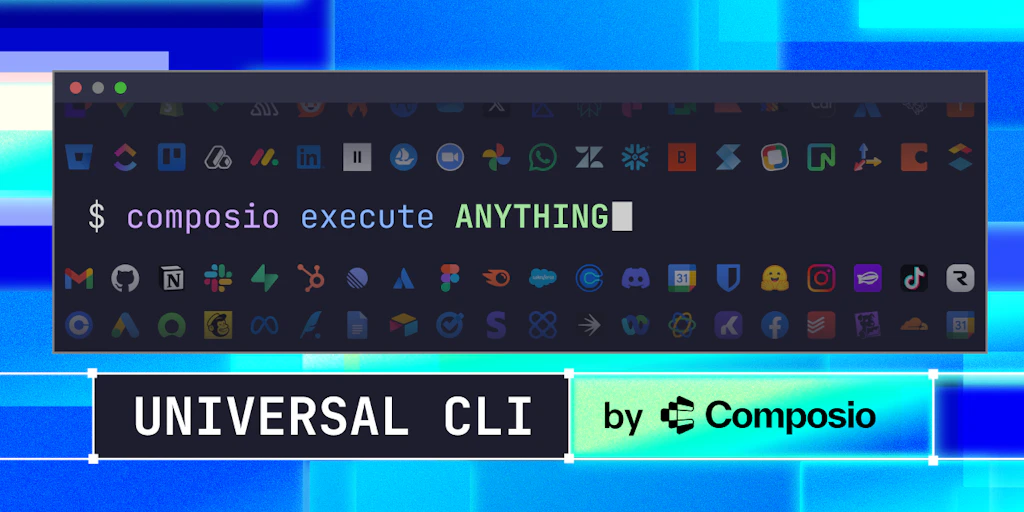
Foto: Product Hunt AI
Up to 100 different programming tools and applications can now be operated from a single terminal thanks to Universal CLI, a new solution from the Composio team. This breakthrough open-source tool eliminates the need for tedious configuration of separate command-line interfaces for each individual service. Instead of installing dozens of libraries, developers receive a unified ecosystem allowing for instant authorization and management of platforms such as GitHub, Slack, Gmail, or Jira using simple, consistent commands. The practical implications for the creative technology sector are immense – Universal CLI drastically reduces the time required to build AI agents and automate workflows. Thanks to a built-in session and authentication management mechanism, creators can focus on the logic of their applications instead of wasting hours debugging API integrations. In an era of growing popularity for autonomous agents, such a solution becomes the foundation for a new generation of software capable of independently navigating between different work environments. Universal CLI not only organizes the developer's toolkit but, above all, lowers the entry barrier for advanced business process automation. It is a step toward full interoperability of tools that, until now, functioned in isolated silos.
In a world dominated by graphical interfaces and increasingly complex SaaS ecosystems, returning to the roots in the form of the command line seems like a move against the grain. However, Universal CLI from Composio proves that the terminal is not just a relic of the past, but the foundation of a new era of automation driven by artificial intelligence. This tool challenges fragmented workflows by offering a single, cohesive gateway to hundreds of applications we use every day, eliminating the barrier between the local development environment and cloud services.
What sets Universal CLI apart is not just being another API wrapper, but an attempt to create a universal language for communicating with software. The developers behind the Composio project understood that the biggest problem in modern productivity is not a lack of tools, but their fragmentation. Switching between browser tabs, authorizing dozens of tokens, and manually moving data between Slack, GitHub, and Jira is a "work tax" that Universal CLI intends to abolish once and for all.
An architecture of connectivity without borders
The foundation of Universal CLI is a powerful integration library that covers over 100 popular platforms. Instead of writing dedicated scripts for each tool individually, the user receives a standardized interface. The system is based on intelligent action mapping, which means that commands executed in the terminal are instantly translated into specific API calls on the service provider's side. This is a "plug-and-play" approach brought to the level of code and system automation.
Read also


In practice, this means that with a single command, we can manage repositories on GitHub, a Google Calendar, or databases in Notion. A key aspect here is security and authentication management. Composio takes on the burden of handling OAuth protocols and key rotation, which is a huge convenience for developers building their own agentic AI systems. We no longer have to worry about how to securely connect our local script with an external ecosystem – Universal CLI acts as a secure intermediary.
- Instant integration with GitHub, Slack, Discord, and Jira.
- Support for advanced AI actions thanks to native support for agentic frameworks.
- Simplified authentication process through centralized token management.
- Ability to execute complex multi-step actions from a single command line.
Agentic AI and the terminal as a command center
The true power of Universal CLI manifests when combined with AI agents. In the era of models like GPT-4o or Claude 3.5 Sonnet, the biggest limitation of artificial intelligence is its "confinement" within a chat window. Agents need hands to act in the real world – to send emails, fix bugs in code, or update task statuses. Composio provides these "hands" in the form of a toolset that AI can invoke autonomously through the terminal.
Thanks to Universal CLI, building an agent that can scan GitHub issues, summarize them, and send a report to Slack becomes a matter of a few lines of configuration. This tool becomes the execution layer that allows large language models to realistically interact with the operating system and external applications. This is a critical step toward the full autonomy of technical assistants, who stop being just advisors and become active members of the development team.

Eliminating friction in development processes
Analyzing Universal CLI from a software engineering perspective, the greatest value is the reduction of so-called "context switching." Every change of context – moving from the IDE to a browser to check API documentation or deployment status – costs time and mental energy. Composio allows you to stay in the terminal, which for many programmers is the state of ideal flow. The ability to query an Airtable database or send a message on WhatsApp directly from the command line drastically shortens the information loop.
It is also worth noting the aspect of universality. The tool is not limited to one specific programming language or operating system. As a CLI, it is inherently agnostic, allowing for easy implementation in CI/CD pipelines. We can imagine a scenario where, after a successful automated test, Universal CLI automatically updates documentation in Confluence and reserves time for a demo meeting in the team's calendar. This is automation that previously required writing and maintaining hundreds of lines of "glue code."
"Universal CLI from Composio is not just a tool, it's a new philosophy of work, where the boundary between the local computer and the global network of services blurs at the level of a single command."
Despite its huge potential, this tool presents some challenges to users. The learning curve, though low thanks to good documentation, requires a change in habits. Relying on a single intermediary for all key integrations builds a certain level of dependency on the Composio platform. However, the benefits derived from the speed of deploying new features and the ease with which complex operational bots can now be created significantly outweigh these concerns. In a world where time is the most valuable currency, Universal CLI offers a real return on it through the intelligent consolidation of a fragmented work environment.
Looking at the direction of creative technology development, Universal CLI fits into the "headless software" trend – software that doesn't need its own UI to be useful. In the future, we won't be clicking buttons; instead, our scripts and AI agents will communicate directly with services. Composio is building the infrastructure for this scenario, making the terminal the most advanced command center we have ever had at our disposal. This is a paradigm shift that will define the efficiency of technical work in the coming years.
More from Tech


Related Articles

After court loss, RFK Jr. gives himself more power over CDC vaccine panel
Apr 6
Steven Spielberg Still Wants to Make a Horror Film ‘Someday’
Apr 6New Jersey has no right to ban Kalshi's prediction market, US appeals court rules
Apr 6