Anvil
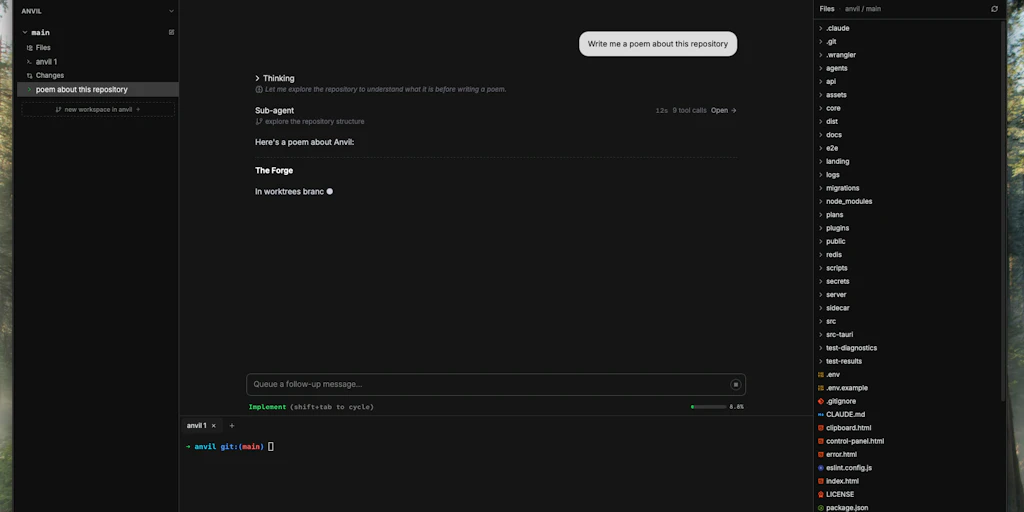
Foto: Product Hunt AI
Seven years of intensive research and development have culminated in the premiere of Anvil—a proprietary next-generation physics engine that redefines how artificial intelligence interacts with matter in virtual environments. This breakthrough solution moves away from traditional rendering methods in favor of deep particle simulation, allowing for the real-time generation of ultra-realistic destruction effects, fluid dynamics, and complex material structures. Through integration with advanced machine learning models, Anvil can predict object behavior with a precision that previously required the immense computing power of render farms. For the global community of creative professionals and developers, this means a drastic lowering of entry barriers for the production of high-budget 3D content and visual effects. Users gain a tool that automates the most tedious processes of physical animation, allowing them to focus on the artistic layer rather than the technical limitations of software. The practical implementation of Anvil into creative workflows enables the creation of interactive worlds that react to user actions in an organic and unpredictable manner. This technology is becoming a new standard in the AI ecosystem, forcing competitors to abandon static models in favor of full, dynamic reality simulation. This paves the way for a new era of digital craftsmanship, where the boundary between simulation and video footage becomes nearly imperceptible to the human eye.
In the developer tool ecosystem, where the barrier to entry between an idea and a working web application still seems too high for many engineers, Anvil emerges. It is a platform that challenges the traditional approach to Full Stack Development by eliminating the need to juggle multiple programming languages, JavaScript frameworks, and complex server configurations. For the creative and technology industries, where time-to-market is a key indicator of success, Anvil represents a radical simplification of the software building process.
The foundation of Anvil is the "Python-only" philosophy. This means a developer can build the user interface (front-end), business logic, and manage the database (back-end) using only the Python language. In a world dominated by React, Vue, or Angular, the proposal to shift the weight of UI creation to a language primarily associated with Data Science and AI is a bold step that hits the mark for thousands of data analysts and engineers bored with the "dependency hell" of modern web development.
Seamless Architecture and Visual Design
Anvil provides a powerful browser-based IDE that combines an intuitive drag-and-drop editor with a professional code editor. Interface design is done by dragging components, such as buttons, tables, or charts, directly onto the application canvas. A key differentiator is that each of these elements is a native Python object, to which events and logic can be assigned without writing a single line of JavaScript.
Read also



This approach eliminates one of the biggest pain points of application development: communication between the front-end and back-end. In the traditional model, a developer must design an API, handle asynchronous requests, and manage data serialization. In Anvil, calling a function on the server from the browser level boils down to a simple anvil.server.call() instruction. The entire communication layer is hidden under the hood, allowing focus on delivering business value rather than fighting with the HTTP protocol.
- Visual designer: Creating UI without knowledge of HTML/CSS.
- Integrated database: A built-in data storage system based on PostgreSQL with access via Python.
- One-click hosting: Publishing applications in the Anvil cloud or on your own infrastructure.
- Integration with the Python ecosystem: The ability to use libraries such as Pandas, NumPy, or Scikit-learn directly in the application.
Democratization of AI and Data Science on the Web
The greatest potential of Anvil is revealed in the hands of artificial intelligence and machine learning specialists. Currently, the industry standard is creating models in Jupyter Notebooks, which then "gather dust" in repositories because the process of transforming them into a useful tool for the end customer requires the involvement of an entire web team. Anvil shortens this path to a minimum, allowing data researchers to independently publish interactive dashboards and predictive tools.
Thanks to the Uplink feature, the platform can connect to any Python script running on a local computer, an office server, or in a computing cluster in the AWS/GCP cloud. This allows for building web interfaces for processes that require powerful GPU units or access to local files, while maintaining full security and control over the data. It is a hybrid solution that combines the lightness of a web application with the raw computing power of on-premise infrastructure.
"Anvil is not just another No-Code tool. It is an All-Code platform that simply chooses one, most powerful language and optimizes the entire creative process around it."
Enterprise-Grade Scalability and Security
A common concern when choosing "all-in-one" platforms is the issue of scalability and so-called vendor lock-in. Anvil addresses these concerns by opening its runtime engine. The Anvil App Server is available as Open Source, which means applications built on the platform can be exported and run on your own Linux server using Docker. This is a critical aspect for companies concerned about data sovereignty and avoiding dependence on a single cloud service provider.
Regarding security, the platform offers built-in authorization and authentication mechanisms, OAuth support (login via Google, Microsoft, GitHub), and granular permission management for database tables. The developer does not have to worry about SQL Injection or Cross-Site Scripting (XSS), as the framework automatically handles data sanitation and secure communication between application layers. For teams operating in regulated industries, such as Fintech or Healthtech, these built-in safeguards drastically shorten the code audit process.
It is also worth noting how Anvil handles version control. Every application is effectively a Git repository. Changes can be tracked, rolled back, and teamwork takes place on branches, which is the standard in professional software development but a rarity in Rapid Application Development tools. The platform allows for seamless switching between development, testing, and production environments, minimizing the risk of errors when deploying new features.
A New Standard for Rapid Prototyping
In the world of creative technologies and AI, where new Large Language Models (LLM) and libraries appear every week, the ability to iterate quickly is more valuable than ever. Anvil positions itself not as competition for major JavaScript frameworks in building social networks for millions of users, but as the fastest path to creating functional, secure, and scalable business tools and applications supporting AI processes.
It can be expected that platforms like Anvil will lead to the emergence of a new class of "hybrid engineers" — individuals who are not full-time web developers but, thanks to proficiency in Python, will be able to deliver complete digital solutions without relying on IT departments. This shift of focus toward logic and data, at the expense of technical interface implementation details, is the natural direction for the development of modern software.
More from Tech


Related Articles

After court loss, RFK Jr. gives himself more power over CDC vaccine panel
Apr 6
Steven Spielberg Still Wants to Make a Horror Film ‘Someday’
Apr 6New Jersey has no right to ban Kalshi's prediction market, US appeals court rules
Apr 6