Bounce Connect
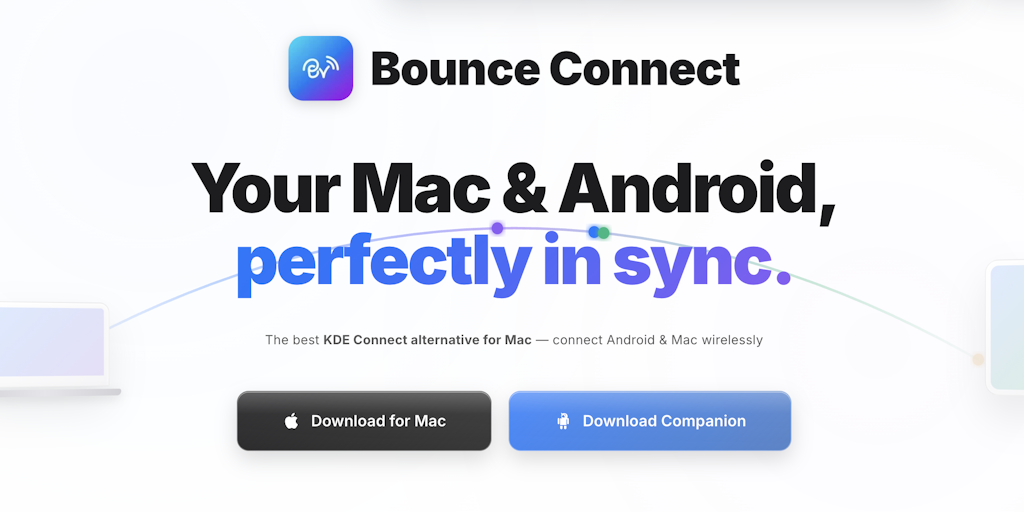
Foto: Product Hunt AI
Bounce Connect is a new tool that will synchronize your Android with your Mac — everything in one place. The application supports SMS messages (including dual SIM), phone calls, notifications, file transfer, and universal clipboard. Key difference: everything works locally, without the cloud, with end-to-end encryption. For a one-time payment of $10.99, you get full device integration. You can reply to SMS messages directly from your Mac, manage calls (including WhatsApp) and quickly transfer files. No subscriptions, no data sent to servers — everything stays on your device. For users working on both platforms, this is a significant convenience. Instead of switching between devices, you handle everything from your Mac. Particularly useful for those who value privacy and don't want to rely on cloud solutions. Bounce Connect is entering the market at a time when integration between Android and macOS systems remains insufficient.
When I last checked my Mac screen, I realized how absurd it is that I constantly have to reach for Android to answer an SMS or take a call. This is exactly the kind of daily irritation that Bounce Connect aims to eliminate. An app that's just debuting on Product Hunt promises full synchronization between macOS and Android — no cloud, no servers, no compromises on privacy. For a one-time payment of $10.99.
This is not another startup experiment that will disappear from the market in a year. This is a solution for a specific problem that will affect anyone who works on a Mac and has Android in their pocket. In an era when Apple controls the iOS ecosystem with an iron fist, and Android remains an open platform, Bounce Connect occupies a unique niche — it bridges two worlds that smartphone and computer manufacturers deliberately keep apart.
Why synchronization between macOS and Android is still a problem
Apple's ecosystem is incredibly integrated, but only for users who stay within its boundaries. If you have an iPhone and a Mac, everything works seamlessly — messages, calls, files, notes. But what happens when you choose Android? Suddenly you're in technological purgatory. macOS doesn't know you have a phone. Your phone doesn't know you're working on a computer. Each device lives its own life.
Read also


Google tries to solve this problem through Phone Link in Windows, but macOS? There's nothing here. Mac users with Android phones have to use weak workarounds — third-party apps that synchronize data through the cloud, which raises security questions, or simply live with disconnection. This is a market gap that technology manufacturers deliberately don't close, because everyone wants you to stay in their ecosystem.
Bounce Connect enters exactly this gap. It doesn't try to be a universal solution for everyone. It focuses on one thing: connecting a Mac and Android in a way that actually works, without intermediaries and without the cloud.
Cloud-free architecture — is it really more secure?
The claim that an app is "fully local" and "encrypted" are two words that everyone should take with some reservation. Bounce Connect synchronizes data directly between devices — it doesn't send anything to servers. This theoretically means your SMS messages, calls, and files never leave your devices. But how does this actually work in practice?
The app must somehow communicate between the Mac and Android. Is it through WiFi on the same network? Through Bluetooth? Through some encrypted tunnel over the internet? The technical details on the product page are surprisingly sparse. This is the first red flag. If something claims maximum privacy, it should be transparent about how it achieves this. The lack of this transparency raises questions.
On the other hand, the "local-first" approach makes sense. Even if data passes through the internet, if it's encrypted end-to-end and never reaches the company's servers, it's actually more secure than cloud-based solutions. But again — without technical details, it's hard to verify. This is the moment when the user has to trust the creators.
Functionality — what exactly can you do
Bounce Connect promises the following capabilities:
- SMS synchronization and responding to them — with dual SIM support, which is important for people working with multiple numbers
- Call management — receiving and making calls from your Mac, with support for WhatsApp as well
- Notification synchronization — you no longer need to check your phone to know what's happening
- File transfer — quick transfer of documents, photos, and other data between devices
- Universal clipboard — you copy text on Android, paste on Mac, and vice versa
This is a solid set of features. It's nothing revolutionary — Windows Phone Link has offered similar capabilities to Windows and Android users for years. But for macOS users, this is practically the first time such a thing is available in a professional way. The fact that the price is a one-time $10.99 and not a subscription is refreshing. It means the creators believe in their app and don't want to constantly extract money from users.
However, there's a catch. The app requires both the Mac and Android to be on the same WiFi network, or for a connection passing through the internet to be established manually. This is not as convenient as it could be. If you're in a café and your Mac is at home, synchronization may be limited or not work at all. This is a practical limitation that the creators will have to solve if they want the app to become truly useful.
Comparison with competition and alternatives
There are already solutions on the market that offer similar functionality. AnyDesk or TeamViewer allow remote control of devices, but these are remote work tools, not everyday synchronization. Google Messages synchronizes SMS messages, but only on Android devices and Chromebooks, not on macOS. WhatsApp Web works on Mac, but that's only WhatsApp, not SMS or calls.
Windows Phone Link, as I mentioned, is the closest competition, but it's only available to Windows users. For macOS users, Bounce Connect is practically the first solution that offers such functionality. This gives the app a significant competitive advantage, but also enormous responsibility — it must work flawlessly, because there's nothing to fall back on.
In Poland, where macOS has a significant share among professionals and creators, and Android is the most popular mobile system, Bounce Connect has the potential to become a standard tool. Especially among freelancers, programmers, and creatives who work on Mac and don't want to buy an iPhone just because Apple says so.
Price and business model — is $10.99 fair
A one-time payment of $10.99 is competitive, but it must be considered in context. It's equivalent to about 45 zloty, which is less than the price of a single coffee in a Warsaw café. For a tool that could potentially save you hours a year switching between devices, that's a reasonable price.
However, the business model here is key. If the creators maintain servers to enable synchronization over the internet (which is very likely, despite "local-first" claims), then a one-time payment may not work long-term. Apps require updates, support, infrastructure maintenance. Will $10.99 per user be enough to cover that?
It's possible that Bounce Connect plans to move to a subscription model in the future, or that the price is an introductory offer. This is something potential users should pay attention to. If you like the app and rely on it, and then the price goes up, there could be disappointment.
Technical challenges awaiting the creators
Synchronization between different operating systems is not a simple matter. macOS and Android have completely different architectures, different ways of handling permissions, different approaches to security. Bounce Connect must work on both platforms without any errors, because even a small bug could mean losing important messages or calls.
Specific challenges come to mind: How does the app handle dual SIMs on Android? How does it handle WhatsApp, which has its own encryption? How does it manage access permissions to SMS and calls, which are protected on both platforms? How does it ensure that data is synchronized in real-time, not with delays?
These questions are important because the usefulness of the app depends on their solution. History shows that apps for synchronizing between devices are very difficult to do well.
Prospects for the Polish market and ecosystem
In Poland, the technical ecosystem is quite divided. Many professionals work on Macs, but most regular users have Android. This creates a natural market for Bounce Connect. The app is available on Product Hunt, which means it will reach a tech-savvy audience, but will it reach the mass user?
This depends on marketing and whether the app really works as well as it promises. If the creators focus on the Polish market and support Polish language, they can build a solid user base. But if they leave the app in English and don't actively promote it, it will remain a tool for a niche audience.
In the context of the industry, Bounce Connect shows that there are still unsolved problems in the technology ecosystem. Apple and Google can offer integrations between their own devices, but they don't offer integrations between each other, because it's not in their business interest. This opens doors for independent creators who can propose solutions that corporations don't want to make. This is healthy for the market.
Final assessment and what it means for users
Bounce Connect is a solid tool for a specific use case. If you work on a Mac and have Android, and you'd like better integration between these devices, it's worth trying. At $10.99, the risk is minimal. If the app works, you'll save yourself many clicks and switches. If it doesn't, you'll lose less than on a coffee.
However, the app must prove that it's worthy of trust. It must work reliably, it must be secure, it must be supported and updated by the creators. These are conditions that must be met for Bounce Connect to become a standard tool, not just a curiosity on Product Hunt.
In a broader perspective, Bounce Connect represents a trend that will grow — independent tools that fill the gaps left by large corporations. This is good for innovation and for users who have more and more options to adapt their technology to their needs, rather than the other way around. If Bounce Connect reaches maturity, it could become a benchmark for what integration between macOS and Android should look like.
More from Tech


Related Articles

After court loss, RFK Jr. gives himself more power over CDC vaccine panel
Apr 6
Steven Spielberg Still Wants to Make a Horror Film ‘Someday’
Apr 6New Jersey has no right to ban Kalshi's prediction market, US appeals court rules
Apr 6