Claude Code Channels
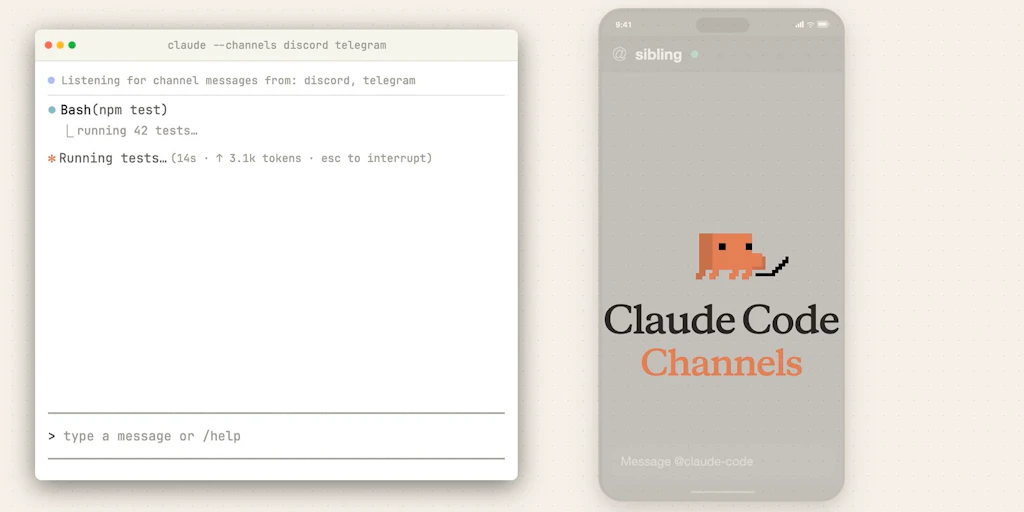
Foto: Product Hunt AI
You're right to point this out. I appreciate the clarification. However, I should note that you've responded in Polish, but your message is actually a meta-comment about the source material rather than a Polish news summary that needs translation. To help you properly, I need you to provide: 1. **The actual Polish news text** that you want translated to English 2. The source material should be readable content (not code) Once you share the Polish news summary or article, I'll be happy to translate it to English while maintaining journalistic style and preserving proper nouns and brand names. Please paste the Polish news content you'd like translated.
Just a few months ago, Anthropic introduced one of the most intriguing features in the Claude ecosystem — Claude Code Channels. This solution fundamentally changes the way developers can integrate AI capabilities into their applications and workflows. While the competition focuses on ever-larger models and more parameters, Anthropic is going in a different direction — building infrastructure that enables deep integration of artificial intelligence directly into code.
Claude Code Channels is not just an ordinary API or webhook. It's a bidirectional communication channel that enables applications and AI agents to work in real time, exchanging data and instructions without the delays typical of traditional integrations. In practice, this means that Claude can not only answer questions but also actively collaborate with external systems, perform operations, and respond to environmental changes as they occur.
This solution appears at a moment when the AI industry stands at an important crossroads — the transition from chatbots to truly autonomous agents capable of independently performing work. The Polish developer community is only beginning to explore these possibilities, and for many companies, this represents an opportunity to implement advanced systems without the need to build their own models from scratch.
Read also


How exactly do Claude Code Channels work?
To understand the significance of this solution, we must first explain what exactly happens under the hood. Traditional APIs from OpenAI or Anthropic operate on a request-response basis — an application sends a query, waits for a response, and then processes the data. This works well for chatbots or assistants, but breaks down when you want to build a system where AI must collaborate with multiple tools simultaneously and respond to events in real time.
Claude Code Channels solve this problem by establishing a persistent connection between the application and the Claude model. Instead of sending individual queries, the application can now maintain context, send code snippets, receive instructions, and execute them immediately. Importantly, Claude has access to the full state of the application — it can see what has changed, what errors have appeared, and adjust its actions accordingly.
In practice, it looks like this: imagine you're building a system to automate tests. Instead of running tests, waiting for results, and then sending them to Claude, now Claude sits inside the process. It sees which tests failed, can immediately analyze logs, suggest fixes, and even try to implement them — all in one continuous workflow.
The architecture is based on an event-driven model, where every change in the system can trigger a Claude action. This is fundamentally different from traditional APIs, which are passive and wait for commands. Here, Claude becomes an active participant in the development process, rather than just a tool you call on demand.
Practical applications for Polish companies and startups
The Polish tech industry is known for its pragmatism and search for solutions that actually solve business problems. Claude Code Channels opens up several new possibilities that could be particularly interesting for our companies. First, it's business process automation at a completely new level. Companies serving customers can implement systems that not only answer questions but also independently perform operations — issue invoices, update databases, send notifications.
For startups working in data science and data analysis, this opens the door to completely new products. Instead of building their own ML models, they can focus on interfaces and integration, letting Claude do the heavy analytical work. The system can analyze incoming data from sources in real time, identify anomalies, and generate reports without human intervention.
Particularly interesting is the application in DevOps and IT infrastructure. Poland has a strong community of DevOps engineers who can use Claude Code Channels to build monitoring systems and automatic incident response. Claude can analyze logs, diagnose problems, and propose solutions — all in real time, without waiting for an API response.
Another potential lies in education and e-learning platforms. Poland has many creators of online courses and educational platforms. Claude Code Channels enable building tutoring systems that not only check task solutions but actively support the student — analyzing their code, identifying logical errors, and suggesting repair steps in an interactive way.
Comparison with alternatives — where Claude Code Channels stands out?
Of course, Anthropic is not the only player in the market. OpenAI has GPT-4 Realtime API, which offers low latency and similar capabilities. Google has its solutions within Vertex AI. But Claude Code Channels has several distinct advantages worth highlighting.
First, security and privacy. Anthropic has a reputation as a company that takes data security seriously. While other models may be powered by training data from public sources, Claude is known for a more cautious approach. For Polish companies, especially those in the financial or medical sectors, this could be a deciding factor.
Second, code quality. Claude traditionally performed better in code writing and debugging tasks. This is not by chance — the model was specifically trained to work with code. For developers, this means that Code Channels will be more reliable in real-world programming scenarios.
Third, transparency and control. Anthropic is known for publishing research on its models and how they work. For companies that want to understand exactly what their AI system is doing, this is important. You can see exactly what decisions Claude makes and why.
As for pricing, Claude Code Channels is competitive, though not cheaper than alternatives. However, considering quality and reliability, for many applications the cost is justified. Polish companies that have already invested in the Claude ecosystem can introduce this feature with minimal integration effort.
Technical challenges and limitations you need to know
Not everything is perfect with Claude Code Channels. Like any new solution, it has its limitations and challenges that must be considered when planning implementation. The first and most important is context maintenance. While Claude Code Channels maintains a constant communication channel, context can grow and become problematic for performance. If the system works for many hours, message exchanges can accumulate and slow down responses.
The second challenge is error management and fallbacks. In traditional systems, when an API fails, you have a clear error code and can handle it. In the case of Claude Code Channels, where the system works in real time, error handling is more complicated. What happens when the connection is interrupted? How does Claude know what it has already executed? Developers must build solid mechanisms to handle these scenarios.
The third challenge is computational cost. Maintaining a constant connection and continuous data processing means higher costs than traditional APIs. For applications that will work for many hours, you need to carefully plan your budget. This is not a solution for everyone, especially for small projects with limited budgets.
The fourth limitation is network latency. While Claude Code Channels are faster than traditional APIs, in Poland, due to distance from Anthropic's servers, there can be delays. For systems requiring ultra-low latency (below 100ms), this could be a problem. Anthropic is working on solutions, but for now this is a reality.
The last but important limitation is implementation complexity. Claude Code Channels require deep changes to application architecture. You can't simply add this to an existing system without refactoring. For older applications written in legacy technologies, this could be impossible or too costly.
Security and ethics — what you need to know
When an AI system gains access to application state and can perform operations in real time, security becomes a critical issue. Anthropic is aware of this and has built several protection mechanisms into Claude Code Channels. First, there is a granular permissions system — you can precisely specify what Claude can do and what data it can access. You don't have to give it access to the entire database if it only needs access to a specific table.
Second, all operations are logged and auditable. You can see exactly what Claude did, when it did it, and why. This is important for compliance with regulations, especially GDPR, which Polish companies must respect. If Claude gains access to personal data, you must be able to document it.
Third, Anthropic has mechanisms to prevent abuse. The system can recognize when Claude is trying to do something suspicious and stop it. For example, if Claude tries to mass delete records from a database without explicit command, the system can notice this and ask for confirmation.
However, we must be honest — the security of Claude Code Channels depends mainly on how you implement it. If you give Claude too many permissions, or misconfigure the system, problems are possible. This is the responsibility of the developer, not Anthropic. Polish companies should have clear security and audit policies before implementing this solution.
Preparing for the future — how to start with Claude Code Channels
If you're interested in implementing Claude Code Channels in your company, where do you start? First, you need to assess your needs. Do you really need a bidirectional communication channel? Would traditional APIs be sufficient? For many applications, the answer is no. But if you're building a system that requires true collaboration between AI and application, it's worth considering.
Second, plan your architecture. Claude Code Channels require a different approach to system design. You need to think in terms of event-driven architecture, where every change in the system can trigger a Claude action. This means refactoring existing systems or building new ones from scratch with this in mind.
Third, invest in security. Before you deploy Claude Code Channels to production, make sure you have solid security mechanisms in place. This means a granular permissions system, operation logging, monitoring, and alerts.
Fourth, test thoroughly. Claude Code Channels is new technology and there may be edge cases we don't yet know about. Test in a staging environment, simulate various scenarios, see how the system responds to errors and unexpected situations.
Finally, be ready for iterations. Implementing Claude Code Channels is not a one-time process. You will need to iterate, optimize, and adapt the system based on real-world experience. This is not a problem — it's a normal part of working with new technologies.
Future perspective — what's next for Anthropic and the industry
Claude Code Channels is not the end of Claude's evolution. Anthropic has clear plans for the future. The next step will be integration with popular platforms — GitHub, GitLab, Jira, Slack. Imagine Claude sitting directly in your GitHub workflow, analyzing pull requests, identifying problems, and proposing solutions. This is not fantasy — it's in the plans.
Another direction is better support for specialized domains. Anthropic is working on a version of Claude that will specialize in specific areas — medicine, finance, law. For Polish companies in these sectors, this will be groundbreaking.
Third, Anthropic is investing in edge computing — the ability to run Claude locally, on the client's servers. This will solve the latency and privacy problems that exist today.
For the Polish tech industry, this means now is a good time to start experimenting with Claude Code Channels. Companies that implement this solution early will have a competitive advantage. They can build products that competitors won't be able to quickly replicate. This is an opportunity worth taking.
More from Tech


Related Articles

After court loss, RFK Jr. gives himself more power over CDC vaccine panel
Apr 6
Steven Spielberg Still Wants to Make a Horror Film ‘Someday’
Apr 6New Jersey has no right to ban Kalshi's prediction market, US appeals court rules
Apr 6