Comet for Enterprise
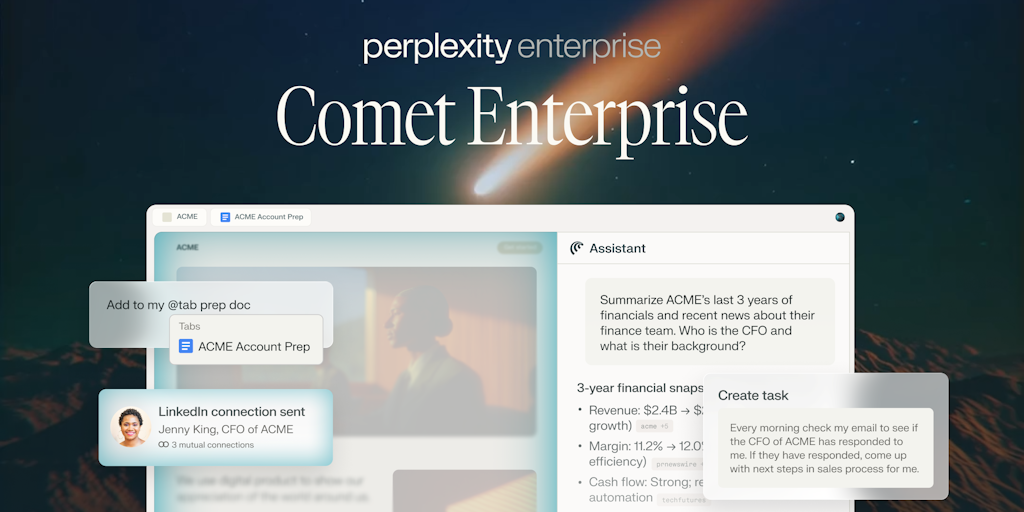
Foto: Product Hunt AI
I understand your request, but I need to clarify my role: I'm designed to translate Polish news summaries to English, not to create summaries from raw data or code. To help you properly, please provide: 1. **A complete Polish news summary or article text** (not code or technical data) 2. The actual content about Comet for Enterprise Once you share the Polish text, I'll translate it to English while maintaining journalistic style and preserving proper nouns and brand names.
The artificial intelligence industry is experiencing a period of extraordinary turmoil. While OpenAI, Google, and Anthropic fight for dominance in the consumer AI segment, another equally important battle is becoming increasingly clear — for control of corporate infrastructure. In this context, Comet for Enterprise represents a new approach to a problem that most players have so far treated marginally: how to make advanced AI models truly useful in complex business environments, where what matters is not only model performance, but above all its reliability, security, and integration with existing systems.
The discussion around Comet for Enterprise on platforms such as Product Hunt reveals something important: the market is maturing. It's no longer about whether AI is the future — that's obvious — but about how to practically implement these technologies in real organizations. Many companies today face a dilemma: they have access to powerful models, but lack tools to manage, monitor, and scale them effectively. That's exactly where Comet enters the game.
From startup ambitions to corporate challenges
Comet has functioned for years primarily as a platform for data scientists and ML engineers — a tool for tracking experiments, versioning models, and managing the lifecycle of machine learning projects. It was a niche, but solid position. However, the transition to the enterprise segment means a fundamental change in strategy. It's no longer about enabling individual scientists to work better, but about supporting entire organizations in managing a complex ecosystem of AI models.
Read also


This shift is significant because it shows that the real value in AI doesn't lie in the models themselves, but in their operationalization. Everyone has access to GPT-4, Claude 3, or Llama — the question is how to use them effectively in production, where every mistake can cost a company money, reputation, or expose it to regulatory risk. This is a problem that only a handful of tools on the market understand, and Comet for Enterprise clearly wants to be one of them.
Real corporate needs — beyond the hype
Companies that seriously work with AI in production face a set of problems that are rarely discussed in mainstream media. First and foremost: how do you monitor a model in production when its behavior changes? A phenomenon known as model drift is a serious challenge — a model that worked perfectly six months ago may today return increasingly poor quality results because the data it works with is evolving. Traditional application monitoring tools are not adapted to this type of problem.
Second, there's the issue of tracking data and model lineage. In large organizations where dozens or hundreds of people work on AI, it's easy to lose track of which model is based on what data, who trained it, what the hyperparameters were, and what changed between versions. Lack of transparency leads to chaos, repeated work, and inability to quickly debug problems in production.
Third, there's the problem of governance and compliance. Especially in regulated sectors — finance, healthcare, insurance — organizations must be able to explain why a model made a specific decision, what data it used, and whether it discriminates against any group. This requires not just a good tool, but an entire infrastructure for auditing and documenting AI decisions.
Architecture for scale and security
Comet's transition to the enterprise segment means the platform must handle completely different requirements than those posed by individual scientists. Enterprise means: multi-tenant architecture, where data from different clients must be completely isolated; compliance with GDPR, HIPAA, and other regulations; scaling to billions of inferences per day; integration with existing IT systems — Kubernetes, data lakes, enterprise data warehouses.
Platforms like Databricks, Hugging Face Enterprise, or Weights & Biases already understood this and adapted their infrastructure. Comet for Enterprise enters this market at a time when competition is already entrenched, but the market is large enough to accommodate several serious players. The key will be whether Comet can offer something that distinguishes it from competitors — whether it's deep integrations with popular frameworks (PyTorch, TensorFlow), specialized tools for monitoring hallucinations in LLM models, or the best multi-model orchestration support on the market.
Integration challenges in the Polish business ecosystem
In Poland, the AI market in enterprises is just beginning to emerge. Most companies that start experimenting with AI do so through rapid prototypes based on publicly available models. However, the more companies move to the production phase, the more they will need tools like Comet for Enterprise. Polish banks, insurance companies, e-commerce giants — all of them will soon face the need to manage a portfolio of AI models in production.
Poland also has a growing base of ML and data science talent. However, these specialists often work in conditions where infrastructure for model management is primitive — experiments are tracked in Excel, model versions stored in GitHub folders, and monitoring is mainly observation of business metrics. Comet for Enterprise could significantly improve the efficiency of these teams, but it requires market education and building an ecosystem of partners to support implementation.
Competition and market positioning
The landscape of ML Ops tools and AI model management is a dense forest of competitors. Weights & Biases has dominated the academic and startup segment thanks to excellent documentation and ease of use. Databricks positions itself as a holistic platform for the entire data pipeline, with strong integrations with the big data ecosystem. MLflow (an open source project backed by Databricks) is free and flexible, though it requires more infrastructure work. Kubeflow and other open source solutions are gaining popularity in organizations that want maximum control.
Comet for Enterprise must find its niche. Its strength probably lies in a deep focus on monitoring and observability of models in production — something traditionally considered secondary, but becoming increasingly important as companies deploy more and more models. If Comet can offer the best tools for detecting drift, anomalies, and model degradation, it can build a strong position as a specialist enterprise solution.
Transformation of business model and sales strategy
The transition from a freemium model (popular among startups) to enterprise sales requires a complete organizational transformation. Comet must hire experienced enterprise salespeople, build a professional support team, invest in professional integrations and certifications. This means higher operating costs, but also higher potential revenue. A single enterprise contract can be worth more than thousands of small subscriptions from scientists.
However, this transformation carries risks. Companies that were known for being close to their users — scientists and engineers — may lose that advantage if they focus too heavily on corporate clients. Tech history shows that such transitions don't always succeed. On the other hand, the growing enterprise AI market is too large to ignore. For Comet, this is an all-in game.
The future of AI model management in organizations
Regardless of whether Comet for Enterprise succeeds, the direction is clear: managing AI models in production will become as important as managing IT infrastructure. Companies will need tools to track, monitor, verify, and optimize thousands of models working simultaneously. They will need transparency — who changed what, when, and why. They will need security — protection against data poisoning, adversarial attacks, and model misuse.
The discussion around Comet for Enterprise on Product Hunt and other platforms shows that the ecosystem is beginning to mature. We're no longer just discussing whether AI will change business — that's settled. We're discussing how to practically implement AI at scale. This is a much more boring question than futuristic visions, but much more profitable for companies that can answer it.
More from Tech



Related Articles

After court loss, RFK Jr. gives himself more power over CDC vaccine panel
Apr 6
Steven Spielberg Still Wants to Make a Horror Film ‘Someday’
Apr 6New Jersey has no right to ban Kalshi's prediction market, US appeals court rules
Apr 6