Doodles Ai
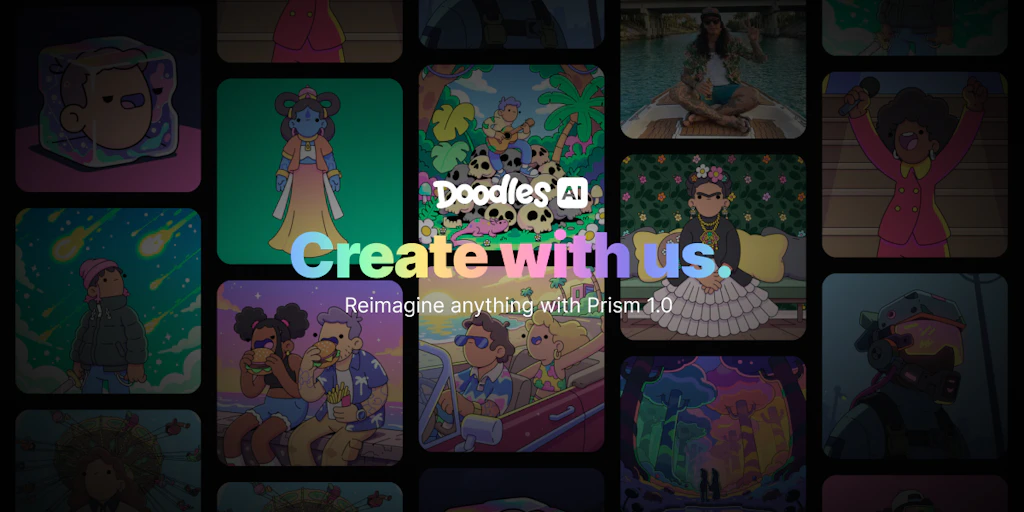
Foto: Product Hunt AI
Doodles AI is a new platform for artists that debuts today with the Prism 1.0 model – a closed neural network trained exclusively on Doodles IP resources. The solution allows anyone to generate studio-quality images, interpreted through the distinctive Doodles aesthetic, in just a few seconds. The key advantage is the absence of risk of style theft or infringement of third-party intellectual property rights – the model works exclusively on its own data. For Doodles and their brand partners, the platform becomes a tool for continuous generation of user-generated content (UGC). Each generated graphic enables audiences to create co-branded visual materials at scale. This solution opens new possibilities for small creators and companies that can now produce professional visualizations without complex design processes. Doodles AI is a response to the growing demand for controlled AI tools that respect copyright while democratizing access to high-quality image generation.
The world of generative artificial intelligence has just changed in a way that many people did not anticipate. Instead of another platform promising "AI for everyone" and hitting all-and-none, Doodles AI has emerged — a tool that does something decidedly smarter: it builds a closed, controlled ecosystem around its own patented intellectual property. This is not another Midjourney or Stable Diffusion with an interface. This is something completely different, and it's worth understanding why this difference matters not only for creators, but for the entire AI market.
The platform, which debuts today, is called Prism 1.0 — a foundational model trained exclusively on Doodles' graphic resources. Does this sound like a limitation? Not at all. This is a strategic decision that solves a problem the AI industry has been wrestling with for years: how to generate artistic content without stealing the styles of third-party artists, without infringing on copyrights, without endless legal disputes.
Doodles AI is the answer to the question everyone has been asking: can you build generative models that are both powerful and ethical, both scalable and responsible? The answer is: yes, but you have to be ready to build something from scratch.
Read also

Prism 1.0: A Model That Knows Exactly What to Do
Instead of training a model on billions of images from across the internet — as ChatGPT or DALL-E do — Doodles went in a completely different direction. Prism 1.0 is a foundational model that learned exclusively from its own controlled dataset. This means that when you generate an image, the algorithm is not trying to imitate Picasso, Warhol, or contemporary artists. It generates visualizations through the prism of Doodles' aesthetics — a distinctive, recognizable style that the brand has built over the years.
This approach has several consequences that the industry should take to heart. First, it eliminates the problem of style theft. When you generate an image in Doodles AI, there is no risk that the algorithm drew heavily enough from a particular artist's work for their style to be recognizable in the output. The model simply does not have access to such data. This makes the entire platform more legally defensible — both for Doodles and for its users.
Second, Prism 1.0 is a closed and controlled model. Unlike open-source models that anyone can download and train on whatever they want, Prism remains Doodles' property. This means that the brand has full control over how the model evolves, how it is used, and what impact it has on the market. This may sound less "democratic" than open models, but in practice it provides much greater assurance of safety and brand consistency.
The third consequence is perhaps the most important: the quality of generated images is predictable. Each generation passes through the prism of the same, well-defined style. This means that branded materials generated by users look consistent, professional, and always remain within the visual identity of Doodles. This is enormously important for brands that want to use this tool to create marketing materials.
UGC Generator on Steroids: How This Changes the Marketing Game
Doodles AI does not position itself as a tool for artists or designers looking for a creative challenge. Instead, the platform says plainly: we are a user-generated content (UGC) generator on steroids. This is a fundamental difference in approach, and it has gigantic implications for the marketing and content creation industry.
Imagine this scenario: you have a brand that wants to launch a campaign where hundreds of thousands of users generate co-branded materials. Traditionally, this would mean hiring designers, creating templates, moderating submissions, fighting with visual inconsistency. With Doodles AI, the user opens the app, clicks a few times, and in seconds receives a studio-grade image — professional graphics that look like they were created by an experienced designer.
For Doodles and their brand partners, this means almost unlimited potential for creating content at scale. Each generation is another piece of the campaign, another touchpoint with a potential customer, another opportunity to build community. The platform becomes a always-on UGC engine — always ready, always available, always consistent.
Importantly, the model is powerful enough to generate "studio-grade" images — that is, high enough quality that they can be used directly in marketing materials without additional processing. This changes the economic equation for small and medium-sized brands that previously could not afford to create large quantities of professional graphics. Now they can.
Closed Loop: Why Control Over Data Is the Future of AI
When the AI industry talks about "closed-loop," it usually means feedback systems that learn from every interaction. But in the case of Doodles AI, "closed-loop" means something more fundamental: complete control over training data, the learning process, and results.
This stands in contrast to the model that has dominated the industry for years. OpenAI, Anthropic, Google — they all train their models on billions of texts and images scraped from the internet. This gives enormous power and versatility, but comes with several problems. First, no one knows exactly what data ended up in the training set. Second, models can accidentally reproduce the styles of specific artists in ways that border on plagiarism. Third, anyone can download the model and train it further on whatever they want.
Doodles' approach is radically different. Instead of training on the entire internet, the model learns exclusively from a controlled set of graphics belonging to Doodles. This means that:
- Every image in the training set is known, catalogued, and belongs to Doodles
- The model cannot "leak" the styles of third-party artists because it simply never saw them
- Each generation is legally clean — it does not infringe on anyone's copyright except Doodles'
- The brand has full control over the evolution of the model and its applications
This approach will become increasingly popular. Not because it is more "democratic" or "open" — because it is not at all. But because it solves real problems: legal liability, brand consistency, predictability of results. Large corporations that have the resources to build their own models will increasingly go this route. Doodles shows that this is possible right now.
No Style Theft: A Solution to a Problem No One Could Solve
Over the past two years, the generative AI industry has fought legal battles with artists. Artists argued — and they were right — that models like Stable Diffusion or DALL-E were trained on their work without consent, without compensation, and could reproduce their styles in ways that actually harmed their careers. Courts began siding with artists. Legislators began writing regulations. The industry was in chaos.
Doodles AI sidesteps this problem entirely. If the model is trained exclusively on its own data, then there is no style to steal. This is not a solution that will satisfy everyone — many artists and activists will argue that the industry should be more open, more shared, more democratic. But from a practical, legal, and business standpoint, this is a brilliant solution.
For Doodles, this means they can build an AI business without fear of lawsuits, without needing to negotiate with thousands of artists, without the legal quagmire that has trapped other platforms. They can simply build.
For users of the platform, this means they can generate images with a clear conscience. They are not supporting style theft. They are not contributing to harming artists. They are using a tool that is ethically clean — at least in that regard.
How This Changes the Game for Polish Creators and Brands
In Poland, the market for AI tools for creators is still young, but developing rapidly. Polish marketing agencies, freelancers, small and medium-sized companies are looking for ways to save time and money on creating graphics. Doodles AI enters this gap in an interesting way.
For Polish brands that want to create campaigns with UGC elements, Doodles AI can be significantly cheaper and faster than the traditional approach. Instead of hiring designers, moderating submissions from users, fighting with visual inconsistency — they can simply provide the tool to their audience. Everyone can generate co-branded materials in seconds.
For Polish artists and designers, the situation is more complex. On one hand, tools like Doodles AI can take away some of their work — particularly repetitive work that requires less creativity. On the other hand, the tool is not a threat to high-skilled artists. There will always be demand for creators who can think strategically, who understand audience psychology, who can create campaigns that actually resonate with people. Doodles AI can actually free artists from routine work, allowing them to focus on more creative tasks.
The key question for Poland is: will Doodles AI be available to Polish users? For now, the platform is debuting on Product Hunt, which suggests it will be available globally. If so, the Polish creative industry should start thinking about how to integrate this kind of tool into their workflows.
Limitations: What Prism 1.0 Cannot Do
Of course, every tool has its limitations, and Doodles AI is no exception. A model trained exclusively on one dataset — however good — will have limitations that models with broader training do not have.
First, versatility. If you want to generate images in many different styles — realistic, abstract, retro, futuristic — Prism 1.0 will always filter everything through the prism of Doodles' aesthetics. This is a feature, but also a limitation. If you are looking for a tool that can generate anything in any style, Midjourney or DALL-E will be better.
Second, artistic innovation. A model that has only seen one style cannot really innovate in the way models trained on millions of different artworks can. It can create new combinations of elements, but within a well-defined spectrum. This is not a bad thing — for brands that want consistency, this is an advantage. But for artists looking for new boundaries, it can be limiting.
Third, specialized applications. If you want to generate images for niche industries — architecture, medicine, engineering — Prism 1.0 may not be specialized enough. It was trained to create images in the style of Doodles, not to understand complex industry concepts.
These limitations are not flaws of the platform — they are its features. Doodles AI does not pretend to be a universal AI tool for everyone. It pretends to be a specialized, controlled, ethical tool for brands and creators who want to create content within a defined aesthetic. This is much more realistic and honest than promising that a tool can do everything.
Shift in Balance: From "AI for Everything" to "AI for Something Specific"
If you look at the evolution of the AI market over the past few years, you see a clear trend. First came large general-purpose models — GPT-3, DALL-E, Stable Diffusion. They promised they could do everything. Then specialized models started appearing — LLMs for medicine, models for law, models for specific industries.
Doodles AI represents the next stage of this trend: models built around a specific brand, a specific style, a specific application. This is not a model that pretends to be versatile. This is a tool that does one thing, but does it really well.
This shift has enormous implications. First, it means that the future of AI will not be a few large models dominating the market, but thousands of specialized models, each optimized for a specific application. Second, it means that every large brand will want to have its own model — like Doodles. Third, it means that the industry will have to learn to build small, controlled, specialized models instead of racing to build ever larger general models.
Doodles AI shows that this direction is not only possible, but also commercially sound. Instead of competing with Midjourney or DALL-E on their turf — on the turf of versatility and general purpose — Doodles is building something more specialized, more controlled, more valuable for a specific group of users.
The Future: What This Means for the Industry
If Doodles AI is a success — and everything suggests it will be — we will witness a massive shift in the industry. Large brands that have access to huge amounts of their own data will want to build their own models. Not because they want to be more open or more ethical — though that too — but because it is commercially sound.
Nike will want to have a model trained on its sneaker designs. Coca-Cola will want to have a model trained on its campaigns. Every large brand that has enough data and a large enough budget will want to have its own closed AI model.
This will have consequences for artists, for designers, for the entire creative industry. On one hand, there will be less work for those doing routine work — generating variants, creating marketing materials, work that can be automated. On the other hand, there will be more work for those who can think strategically, who can create campaigns that actually work, who can manage and train AI models.
For Doodles, this means they can become not just a platform for generating images, but also a consultant for other brands that want to build their own models. This is a gigantic business opportunity that the company certainly sees.
Ultimately, Doodles AI is not just another AI tool. It is a signal that the AI industry is undergoing a transformation. From the era of large, general models that are supposed to do everything, we are moving to an era of specialized, controlled, brand-centric models that do one thing, but do it perfectly. Doodles shows that this future is not science fiction — it is here, now, and already happening.
More from Tech


Related Articles
After court loss, RFK Jr. gives himself more power over CDC vaccine panel
Apr 6
Steven Spielberg Still Wants to Make a Horror Film ‘Someday’
Apr 6New Jersey has no right to ban Kalshi's prediction market, US appeals court rules
Apr 6