Fundable API
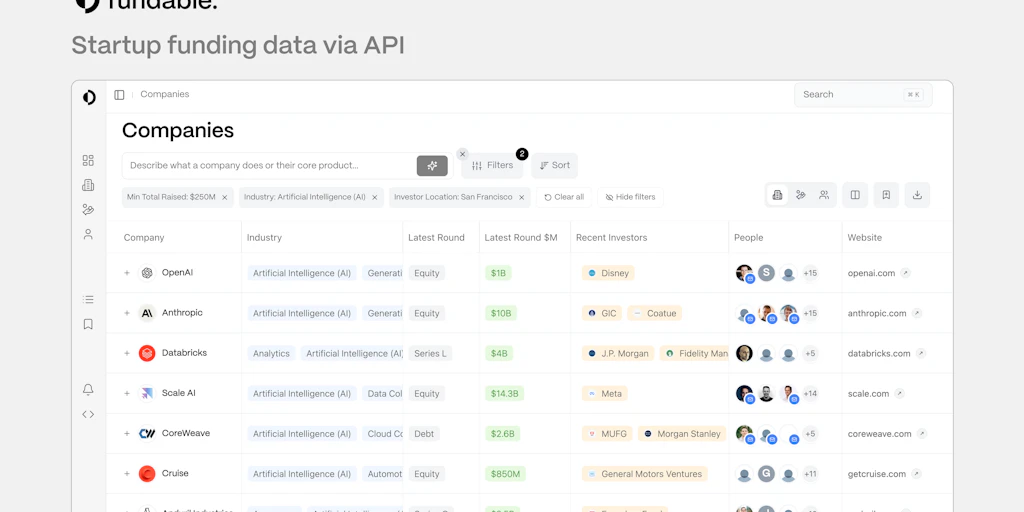
Foto: Product Hunt AI
Fundable launches API for startup, investor and people data today – direct competition for PitchBook and Crunchbase. Key difference: while competitors charge thousands of dollars for API access, Fundable provides an access key immediately after registration, without a credit card. Users can purchase credits on an ongoing basis – the first 200 are free. The platform stands out by surfacing new deals before other services, providing sources for every data point, and offering natural language alerts (e.g., "coding agent startups in SF looking for employees"). The interface is intuitive and pricing significantly lower than competitors. The API can be used to track funding rounds, enrich leads or search for investors. This is Fundable's second launch – the team demonstrates its push to democratize access to venture capital data, previously reserved for wealthier market players.
The venture capital industry has been stuck in a technological slumber for years. While fintech is revolutionizing banking and e-commerce is transforming retail, investors and funds continue to use tools that look like relics from the 2000s. Crunchbase and PitchBook — two giants in startup data — require developers who want to integrate their APIs with their own products to spend thousands of dollars annually. This is not an exaggeration or marketing speak — it's reality that discourages innovators and condemns smaller teams to manual information gathering. This is where Fundable comes in — a platform that not only challenges the giants but proposes something radically different: access to a startup-investor-people database without a credit card, without minimum fees, and even with a bonus of 200 free credits to get started.
Fundable is not just another Crunchbase clone. It's a thoughtful alternative built by a team that clearly understands the pain points of existing solutions. The platform combines three key elements: access to data about startups, investors, and people — all in one place. But here's where it gets interesting. Fundable doesn't just collect data; it allows for natural language queries in English, such as "AI coding agent startup in San Francisco looking for employees". This is not just simple filtering — it's real intelligence that understands context and user intent.
Today, Fundable announces the official launch of its API — the company's second major product premiere. This is a breakthrough moment for the entire ecosystem, as it fundamentally shifts the balance of power in the venture capital data market.
Read also


Why Fundable's API is a threat to Crunchbase
The business model of PitchBook and Crunchbase is based on the assumption that access to information should be expensive. When a startup wants to integrate a competitor's API with its own product, suddenly there's talk of corporate contracts, minimum annual spending, and sales negotiations. For a small team with a budget under a million dollars a year, it's practically impossible. Fundable changes this game by offering something almost shocking in the context of venture capital: democratization of data access.
Fundable's API works on a "pay-as-you-go" model — you pay for credits that you actually use. The first 200 credits are free, allowing for real API testing without any financial commitment. This is not a marketing trick; it's a fundamentally different philosophy. Developers can experiment, build prototypes, and if their idea doesn't work out, they don't lose money. If it does work — they only pay for what they use.
A key difference also lies in data transparency. Fundable provides sources for every data point — you know exactly where the information comes from, whether it's from an official filing, media, or user observation. This builds trust and reduces the risk of relying on unverified information. In the world of venture capital, where investment decisions can be worth millions, this transparency has enormous value.
API on demand — do you really not need a credit card?
Reading Fundable's description, you might laugh at the absurdity of the current state of affairs: "Fundable gives you an API key upon registration, without a credit card, and you buy credits as needed". It sounds almost like a joke — the barriers to entry are so low. But this is not a joke, it's the reality that Fundable is bringing to market.
The traditional flow at Crunchbase looked like this: interest → form → waiting for sales contact → contract discussion → finance approval → finally access. The process took weeks, sometimes months. Fundable shortened it to minutes. You register, receive an API key, and can immediately start making queries. If you want to buy more credits, you add a credit card — but it's optional at first.
This model has deep implications for the Polish startup ecosystem. Polish teams that previously didn't have access to advanced venture capital tools due to costs can now build advanced products based on Fundable's data. A startup from Warsaw working on an investor-entrepreneur matching platform can now integrate Fundable's API without having to negotiate a contract with Crunchbase — which would have been practically impossible for a small team.
Natural language queries: when a database speaks your language
One of Fundable's most intriguing features is the ability to create deal alerts in natural language. Instead of building complicated SQL queries or navigating through filter interfaces, you can simply type: "AI coding agent startup in San Francisco looking for employees". The system will understand your intent and return relevant results.
This is not just keyword search — it's real semantic understanding. Fundable uses natural language processing (NLP) to interpret the query, identify categories, locations, funding stages, and other characteristics, and then return precise results. In practice, this means an investor can monitor the market much more efficiently than before.
For Polish venture capitalists and business angels, this is particularly valuable. Instead of spending hours browsing Crunchbase, they can formulate queries in natural language and receive current information about deals that interest them. Alerts can be tuned to very specific criteria — for example, "Polish startup in deeptech sector seeking Series A". The system will monitor the market in real time and notify about new opportunities.
An interface that doesn't hurt the eyes — and it matters
If you've ever used Crunchbase, you know the interface is functional but boring. It looks like a spreadsheet from the 2010s. Fundable focuses on modern, intuitive design — this might seem like a detail, but in reality, it has enormous significance for user adoption. A tool that is pleasant to use encourages deeper data exploration, and that leads to better investment decisions.
Fundable's interface was designed with how people actually work with venture capital data in mind. Visualizations are clear, search is fast, and results are presented in a way that makes it easy to quickly understand key information. This might seem like a minor point, but in an industry where time is money, a good interface is a competitive advantage.
Price as a weapon — is this sustainable?
Fundable positions itself as a cheaper alternative to Crunchbase and PitchBook. Indeed, the "pay-as-you-go" model with the first 200 free credits is drastically cheaper than annual subscriptions from competitors. But is this sustainable? Can Fundable maintain this price while investing in data quality?
The answer is complicated. Fundable has access to data from many sources — media, official filings, social platforms, venture capital databases. It doesn't have to build everything from scratch. Moreover, the "pay-as-you-go" model means Fundable's revenue scales with usage — if more people start using the API, revenue grows automatically.
However, the question of sustainability is justified. Crunchbase and PitchBook invest enormous sums in data verification, maintaining relationships with venture capital funds, and gathering information from sources that regular platforms don't have access to. Fundable must find a way to compete in this dimension without drastically raising prices — otherwise, its competitive advantage will disappear within a few years.
API applications — from lead generation to venture intelligence
Fundable's API opens possibilities that were previously available only to large corporations with budgets to match. Here are some concrete applications:
- Lead enrichment for B2B sales — if you sell software for startups, you can use Fundable's API to enrich your lead lists with information about funding, team, and growth stage of potential customers.
- Venture intelligence for investors — venture capital funds can integrate the API with their own deal sourcing systems to automatically identify interesting opportunities based on investment criteria.
- Recruitment for startups — HR teams in startups can use data about investors and venture capital networks to identify potential employees with venture capital experience.
- Competitive intelligence — startup competitors can monitor funds that invest in similar solutions and adjust their strategy.
- Media and market analysis — journalists and analysts can use Fundable's API to create reports on venture capital trends.
Each of these applications would have been practically impossible for smaller teams without access to cheap API. Fundable democratizes access to information that was previously reserved for the venture capital elite.
Impact on the Polish startup ecosystem — opportunity or threat?
For Polish venture capital, the launch of Fundable's API is above all an opportunity. Polish venture capital funds — such as Pekao Venture Capital, Spark Capital, or Inovo — can now integrate Fundable with their own deal sourcing systems without having to negotiate contracts with Crunchbase. This means they can work more efficiently, identify opportunities faster, and ultimately, invest better.
For Polish startups building products in the venture capital or fintech sector, this is even better news. They can now build advanced tools without needing access to data from Crunchbase. A Warsaw startup that wants to build an investor-entrepreneur matching platform can now integrate Fundable and have access to data it previously wouldn't have had.
The only potential threat is that if Fundable is adopted by too many users too quickly, there could be scaling or data quality issues. But for now, this is a pure plus for the ecosystem.
Data as the heart — does Fundable have sufficient depth?
Ultimately, the value of a venture capital database depends on one thing: how complete and current the data is. Fundable claims to surface new deals before other platforms — this is an ambitious claim. If it's true, it means Fundable has access to information sources that Crunchbase and PitchBook don't have, or processes them faster.
In practice, this means Fundable must have a network of people in the venture capital ecosystem who inform it about new deals before they appear in media or official filings. This is difficult to build and maintain, but if Fundable has achieved it, it gives them a huge competitive advantage.
However, one question remains: can Fundable maintain this advantage? Crunchbase and PitchBook have the resources and network to quickly adapt. If Fundable becomes too popular, competitors could increase their data collection efforts to keep up. But for now, Fundable has a chance to build user loyalty through a better interface, lower prices, and more intuitive tools.
More from Tech




Related Articles

After court loss, RFK Jr. gives himself more power over CDC vaccine panel
Apr 6
Steven Spielberg Still Wants to Make a Horror Film ‘Someday’
Apr 6New Jersey has no right to ban Kalshi's prediction market, US appeals court rules
Apr 6