Gamers react with overwhelming disgust to DLSS 5's generative AI glow-ups
Nvidia / Capcom
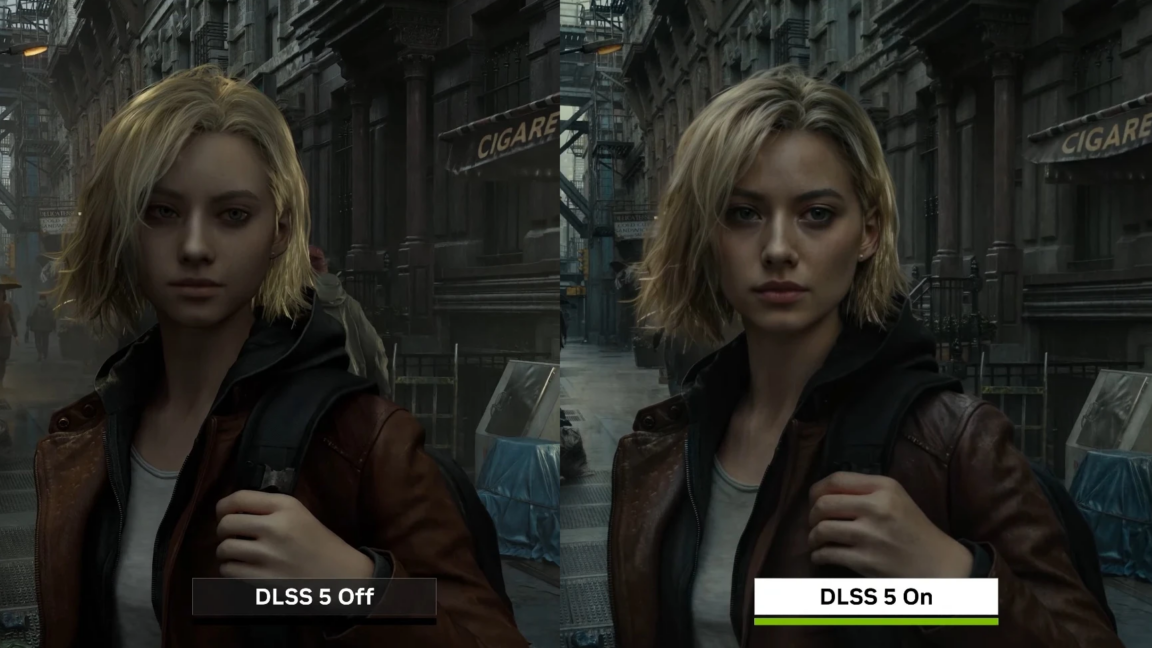
Can artificial intelligence completely change how we see graphics in games? Nvidia sparked huge controversy by presenting DLSS 5 — the latest rendering technology that goes far beyond previous resolution improvements. The newest AI tool proposes a total metamorphosis of graphic scenes, using generative artificial intelligence to transform lighting, textures, and visual details. While previous DLSS versions focused on performance enhancement, DLSS 5 aims to be a "neural real-time rendering model" that can create almost cinematic visual effects. Nvidia's CEO, Jensen Huang, emphasizes that the technology combines generative AI with manually created renders while maintaining artistic control. Despite Digital Foundry's enthusiasm, the gaming community reacted decidedly negatively. Critics point to the artificiality and blurring of the original artistic vision. Does DLSS 5 truly revolutionize computer graphics, or merely uniformizes its aesthetics? The coming months will show how the technology will be received by creators and players.
Nvidia enters the controversial world of generative artificial intelligence in gaming, introducing DLSS 5 — a technology that provokes sharp opposition among the gaming community. This is more than just improving image quality; it's a revolutionary but questionable method of transforming graphics in real-time.
Evolution of Rendering Technology
Since the first release of Deep Learning Super Sampling (DLSS) in 2018 on RTX 2080 cards, Nvidia's technology has systematically evolved. Initially, it primarily served to improve performance and image quality through advanced machine learning techniques. However, DLSS 5 completely changes the previous approach, introducing generative artificial intelligence elements that far exceed traditional scaling methods.
Nvidia's CEO, Jensen Huang, described the new technology as a "neural real-time rendering model" that aims to deliver a level of realism previously achievable only in Hollywood visual effects. The key assumption is combining generative AI with manually created renders while maintaining artistic control.
Read also

How Does DLSS 5 Work?
Unlike existing generative models that are often unpredictable, DLSS 5 uses internal game data such as color and motion vectors. The technology allows for:
- Adding photorealistic lighting
- Precise material rendering
- Understanding advanced scene semantics
- Maintaining consistency between frames
The system can interpret complex elements such as characters, hair, fabrics, skin, and lighting conditions — from headlight to cloudy conditions.
Gaming Community Reaction
Despite the enthusiasm of some analysts, such as the Digital Foundry team, who described the effects as "stunning", the overall reaction from the gaming community is decidedly negative. Many believe that DLSS 5 takes artistic control away from game creators and introduces an artificial, "inhuman" look to graphics.
Technical Implementation Details
It's worth noting that current demonstrations use two RTX 5090 cards, with one entirely dedicated to the DLSS 5 process. This indicates the enormous computational demand of this technology and suggests that it will require advanced hardware.
Perspectives for the Polish Market
For Polish gamers and game creators, known for their attention to detail and artistic quality (as proven by studios like CD Projekt RED), DLSS 5 may pose a serious challenge. It will require rethinking existing graphic design strategies and adapting to the new possibilities of generative artificial intelligence.
Summary: Will AI Revolutionize Gaming?
DLSS 5 is more than just another technological update — it's a signal of upcoming changes in game graphics rendering. Although currently met with criticism, it may mark the beginning of a new era where artificial intelligence will be not just a technical tool, but also a creative support for designers.