GB1: The AI from the UK
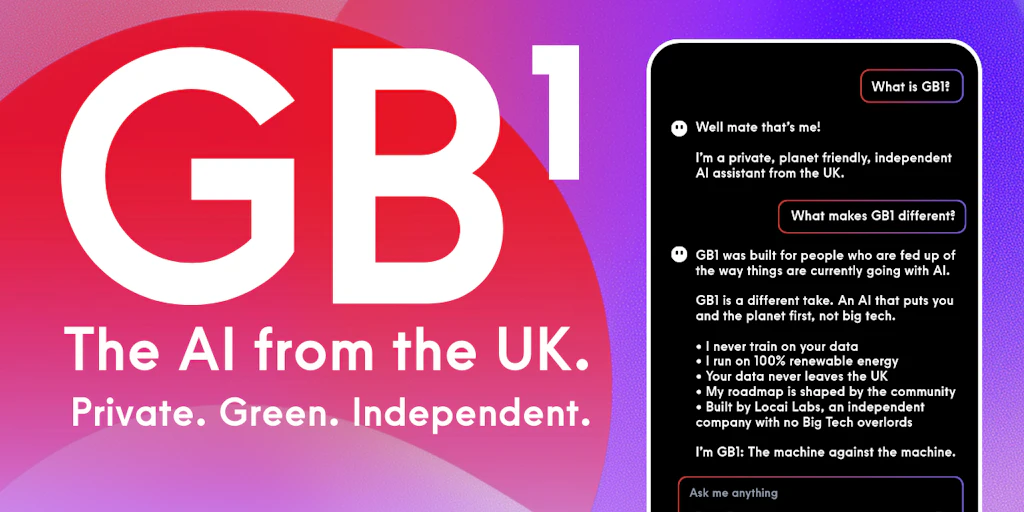
Foto: Product Hunt AI
# British Startup Launches GB1 — AI Assistant as Alternative to Tech Giants A British startup has introduced GB1 to the market — an AI assistant intended to be a genuine alternative to dominant technology giants. The platform operates exclusively on renewable energy from the United Kingdom and never uses user data to train the model. GB1 is based on Locai L1 Large — the first British foundational model — and promises performance comparable to leading solutions, but with complete privacy. User data remains within British territory, and conversation history does not go into any training systems. The platform offers a Spaces feature for project organization, access through web and mobile applications, and users can vote on new features in the product roadmap. GB1 is available for free on both mobile devices and in browsers. This is a significant step toward the decentralization of artificial intelligence — users finally gain the choice of an assistant that does not require compromise between performance and privacy protection. For businesses and private individuals concerned about data security, this is a potentially groundbreaking solution.
British AI comes with a completely different approach to what we do with our data. GB1, a new artificial intelligence assistant just launched on Product Hunt, not only promises privacy — it guarantees it, operating solely on renewable energy and never training on your conversations. This is the differentiation the industry definitely needs, especially when OpenAI and Google are collecting every bit of information to improve their models. GB1 is the answer to a question increasingly more people are asking: do we have to surrender all our digital privacy to use advanced AI?
The launch of this product comes at a moment when European technology is becoming increasingly ambitious. Instead of another American chatbot, we have here the first commercial application of Locai L1 Large — the first British foundational model that has ambitions to rival the giants. This is not a marginal project — this is a statement that Great Britain can build serious AI without engaging in user exploitation.
Why privacy became a sales argument
For years the AI industry operated on a simple model: more data = better model. Every conversation with ChatGPT, every question to Gemini, every prompt to Claude — everything went to company servers, which analyzed it, categorized it, and used it to train the next versions of models. Users either didn't know about it or accepted it as the cost of free access to advanced technology. GB1 breaks this arrangement — it never trains on your data, which means your questions, documents, and conversations remain actually private.
Read also


This is not just a marketing gimmick. European regulation, particularly GDPR, created fertile ground for this type of alternatives. When Meta was fined billions for illegal processing of European users' data, and OpenAI continues to fight lawsuits over training on text without consent — it became clear that a model based on respecting privacy has real market value. GB1 positions itself directly in this space: if you want AI without a guilty conscience, this is it for you.
Polish users should pay special attention to this aspect. If you work with sensitive data — whether in business or research — GB1 offers something that OpenAI simply doesn't guarantee. Data stored on UK servers, no training on your prompts, full control over what happens to your information.
Renewable energy as part of the product's DNA
Besides privacy, GB1 does something that is rarely seen in the AI industry: it operates solely on 100% renewable energy. This is not a marginal fact — training and maintaining large AI models is gigantic energy consumption. OpenAI, Google, Meta — they're all building data centers that feed on power plants. GB1 changes this equation, betting on wind and sun from British farms.
For creators and companies that are starting to pay attention to their carbon footprint, this is an argument not to be overlooked. If your company has net-zero goals, using GB1 instead of ChatGPT is not only a privacy decision, but also one about ecological responsibility. Is this a form of greenwashing? Perhaps, if you're cynical — but it's also a real difference in how the energy powering AI is sourced and used.
The British market is already investing in such solutions. Companies like Anthropic are taking similar steps toward more sustainable AI, but GB1 does it from the very beginning, as part of its identity, not as an additional PR feature.
Locai L1 Large — an unknown player with ambitions
The heart of GB1 is Locai L1 Large, the first British foundational model. This is not GPT-4, it is not Gemini — it is a completely new player in the field. The model's specifications are not yet fully disclosed, but the fact is that it must be advanced enough to compete with established players. If Locai L1 Large really delivers "frontier performance," as GB1 claims, then we have a potential breakthrough in European AI here.
The problem is that unknown models always raise questions. Does L1 Large really match GPT-4, or is it at the level of GPT-3.5? How does it handle Polish text? Can it code as well as Claude? These answers will only appear when users actually start testing it. Product Hunt is the perfect place for this — thousands of technical users will try it and evaluate it honestly.
From a European perspective, this is important. We have here a chance at a real alternative to American and Chinese models, built in Great Britain, with a European approach to regulation and ethics. If Locai L1 Large proves to be solid, then GB1 could become much more than another chatbot — it could become the foundation for an entire European AI ecosystem.
Interface and functionality — design for the user, not for data collection
GB1 offers several interesting features that distinguish it beyond a simple chatbot interface. The ability to create Spaces for projects means you can organize conversations around specific topics — for teams, research, or personal projects. It's somewhat reminiscent of Custom GPTs in ChatGPT, but with an added layer of privacy that OpenAI will never be able to offer at the same level.
Availability on web and mobile is standard, but standards matter. If you work on a mobile device and need quick access to AI without worrying that your questions will be analyzed by advertising algorithms, GB1 gives you that directly. The interface must be intuitive — and Product Hunt will be the best test of whether Locai and the GB1 team really achieved this.
Also interesting is the ability to vote on roadmap features. This is not new — many SaaS products do this — but in the context of AI, where users often feel powerless over the direction technology is heading, this is a gesture worth noting. It gives users real influence over what will be built next.
Business model — free access as an entry point
GB1 starts with free access, which is standard for AI chatbots in 2024. Every player — OpenAI, Google, Anthropic — offers a free tier. The question is: how will GB1 make money? Most logically, it would be a freemium model — free access to basic features, and paid subscriptions for business users, for higher query limits, for advanced features, or for dedicated instances.
For Polish startups and small businesses, this could be an excellent opportunity. If GB1 will be cheaper than OpenAI API or will offer better terms for European companies, it could become the standard in the local tech ecosystem. Especially for companies that have GDPR obligations and need privacy guarantees — this is not an option, it is a requirement.
The profitability of the model will depend on how quickly GB1 gains users and how many of them will be willing to pay for premium. In the AI industry, where competition is brutal and everyone has access to similar models, differentiating through privacy and ethics is a logical strategy — but it requires users to actually value these principles higher than competitors' lower prices.
Competition and positioning in the global market
GB1 enters a market where competition is already fierce. ChatGPT has 100 million users, Claude is gaining popularity among developers, Gemini has access to Google's gigantic ecosystem. How can GB1 stand out? The answer is simple: through values that these players ignore.
OpenAI will never guarantee full privacy — their business model doesn't allow it. Google will not operate solely on renewable energy — it would cost too much. Anthropic does better on safety, but even Claude trains on user data (though less than OpenAI). GB1 occupies a niche that others deliberately leave, because they think it's too small or too costly.
The question is: is this niche large enough? Are there really hundreds of thousands of users who will pay for AI to be sure their data is safe? Europe seems to be the answer — particularly Germany, France, and Great Britain, where regulation and privacy awareness are high. Poland could also be a growth market, especially if GB1 invests in localization and support for the Polish language.
Obstacles and unanswered questions
Despite promising assumptions, GB1 faces several real challenges. First, Locai L1 Large is an untested model — no one outside the creators really knows how well it performs on various tasks. It might be great at some things and weak at others. This will only become clear after weeks of real-world use.
Second, privacy sounds wonderful, but comes with trade-offs. If GB1 never trains on user data, how will it improve its model? It will have to rely on synthetic data, on public datasets, or on limited feedback. This might mean that L1 Large will develop slower than competitors who have access to billions of user conversations.
Third, the question of scale. Maintaining AI on 100% renewable energy as the number of users grows is not a technical problem, but a financial one. Wind and solar farms cost money. If GB1 has to scale quickly, costs could become prohibitive.
Finally, there is the question of trust in the company. Who is behind Locai? What is their track record? Will they really keep their privacy promises, or is this just an initial strategy they'll abandon when they need money? These are questions everyone should ask themselves before fully switching to GB1.
Significance for the Polish market and European tech
From Poland's perspective, GB1 is interesting primarily because it represents something we lack — a European player in AI that has ambitions and financial backing to compete with giants. For years Polish technology has been known for outsourcing, dev shops, and talent leaving for Silicon Valley. GB1 shows that you can build ambitious products in Europe, with a European approach to values.
If GB1 succeeds, it could open doors for other European AI projects. It could show investors that you don't have to go to the States to build something significant. For Polish developers who want to work on advanced technology, this is a signal that options exist beyond emigration.
Additionally, if GB1 will support the Polish language and Polish market with the same commitment as English — which is entirely possible given that they are a European project — it could become a standard tool for Polish companies and creators looking for an alternative to OpenAI and Google. This is not a small thing.
GB1 is not a revolution — it is a pragmatic alternative, built on values that increasingly more people are starting to appreciate. Whether it succeeds depends on whether Locai L1 Large really delivers quality, whether users will be willing to pay for privacy, and whether the team will be able to scale without compromises. These are questions that will only be answered in a few months — but at this moment, GB1 deserves the attention of anyone concerned about where AI is heading and what happens to their data.
More from Tech


Related Articles

After court loss, RFK Jr. gives himself more power over CDC vaccine panel
Apr 6
Steven Spielberg Still Wants to Make a Horror Film ‘Someday’
Apr 6New Jersey has no right to ban Kalshi's prediction market, US appeals court rules
Apr 6