GitAgent
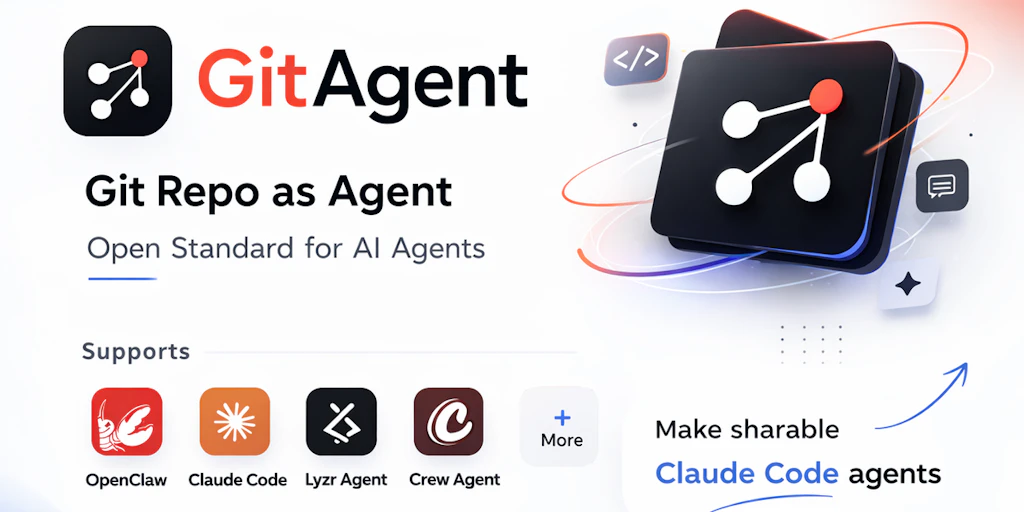
Foto: Product Hunt AI
GitAgent is a new open-source standard that changes the way AI agents are used. Instead of configuring separate systems, a GitHub repository becomes the agent's memory, skills, and identity — all in one place. The project allows defining an agent once and running it anywhere — directly from GitHub to Claude, OpenAI, CrewAI or OpenClaw without any format conversions. Each agent is versioned, reviewed, and fully reproducible. A key advantage is the ability to manage agents like code. You can revert a faulty prompt the same way as a bad commit, create branches for different environments, or send pull requests before deploying changes. This approach makes AI agents an integral part of a developer's workflow, rather than a separate system requiring special handling. GitAgent is entering the market at a time when companies are looking for a more controlled and transparent way to deploy AI agents in production. For technical teams, this means significantly easier maintenance, auditing, and iteration over agents.
GitAgent is a solution that fundamentally changes the way we think about AI agents and version control. Instead of treating a repository as just a place to store code, GitAgent proposes a revolutionary idea: your repository becomes the agent itself. This is not another abstraction or additional layer — it's a paradigm shift where a git-native standard allows you to define an agent directly in your project structure, and then run it everywhere, from Claude through OpenAI to CrewAI and OpenClaw. For the Polish developer community, which is increasingly interested in automation and AI, this could be a turning point in how we organize our projects.
The idea is elegant in its simplicity: you define an agent once, in your repository, and you can run it on any runtime without any reformatting. There's no magic or hidden conversions here — everything is based on an open standard that treats the repo as the agent's memory, its capabilities, and its identity. This means that every change to the agent is versioned, subject to reviews, and fully reproducible — exactly like the code we work with every day.
Repository as agent memory and identity
Traditionally, AI agents were defined through configuration files in JSON, YAML, or even through web interfaces of platforms like OpenAI or Anthropic. Every change required manually updating these files in different places, and synchronizing configuration across environments was a nightmare. GitAgent reverses this model: a git repository becomes the source of truth for the entire agent's identity.
Read also


This means that the agent's memory — all its system instructions, prompts, tool definitions, and parameters — lives directly in your repo. When an agent needs access to its capabilities, it doesn't have to look for them on an external server or in the cloud; everything is available in the project structure. This architecture has deep implications for security, reproducibility, and control. If an agent behaves strangely, you can review the change history, see exactly when and what changed, and revert to a previous version — just like you do with code.
For teams working on complex AI systems, this is a game-changer. Instead of having an agent defined somewhere in the cloud, beyond the reach of version control, you can now treat it like any other project artifact. You can do code reviews for changes to the agent's prompts, require approval before changing its behavior, and even automatically test new versions of the agent before deploying to production.
Git-native standard and multi-platform compatibility
The key advantage of GitAgent is its independence from any specific LLM vendor. You define an agent once — in a repository — and you can run it with Claude, OpenAI, CrewAI, or OpenClaw without any configuration changes. This is possible thanks to an open git-native standard that abstracts the specific requirements of each platform.
In practice, this means that if you decide to switch LLM vendors — for example, from OpenAI to Anthropic — you don't have to rewrite the entire agent configuration. Your repository remains the same, and the only thing that changes is the runtime you run it on. This solves one of the biggest problems in the AI ecosystem: vendor lock-in. Teams will no longer be forced to stick with one vendor because their agents are deeply anchored in their infrastructure.
For Polish startups and tech companies experimenting with AI, this is especially important. Instead of building your entire architecture around one vendor, you can flexibly choose tools based on your needs, budget, and performance. If a new LLM model appears on the market and is better for your use cases, you can easily integrate it without refactoring your entire system.
Versioning, branching, and pull requests for agents
One of the most innovative features of GitAgent is treating agent changes exactly like code changes. You can create branches for different environments — for example, development for experiments, staging for testing, and main for production. Every change to an agent goes through a pull request, where the team can review the new configuration, prompts, or capabilities before deployment.
This is especially valuable for large teams where multiple people work on the same agent. Instead of chaotic parallel changes, you have a clear workflow: someone proposes a change in a new branch, the team discusses and reviews it, and then merges to the main branch. The change history is complete and transparent — every commit contains information about who changed what and when.
Most importantly, if a new version of the agent doesn't work properly, you can easily roll it back — just like you do with a bad code deployment. Instead of manually restoring the previous configuration, you simply revert the commit. This eliminates the stress associated with deploying agent changes, because you know you can quickly return to the previous state.
Practical applications and integration with developer workflow
GitAgent opens up possibilities for a whole spectrum of applications. Imagine an agent that automatically reviews pull requests in your project — its system instructions, list of tools available for code analysis, and parameters are all defined in the repository. When you need to update the review logic, you do it through a regular pull request. Or an agent that handles support — its product knowledge, complaint handling procedures, and integrations with ticketing systems are all versioned in git.
For Polish tech companies building their own AI tools, GitAgent opens up the possibility of offering your users agents that are fully controlled and versioned. Instead of a black box, the user has a transparent, modifiable agent that they can customize to their needs by editing the repository.
Integration with existing developer workflows is seamless. If you already use GitHub Actions, you can easily add automatic agent testing on every push. If you have a CI/CD pipeline, you can extend it with agent deployment. Everything works within the tools you already know and use every day.
Security and control through code
Traditional approaches to configuring AI agents often mean storing sensitive information — API keys, system instructions containing security information — in configuration files outside version control. GitAgent changes this by introducing code review for everything the agent does.
If an agent has access to new tools or permissions, it must be approved through a pull request. Every team member can review these changes and ensure the agent won't do anything dangerous. This is especially important for agents that have access to production systems or sensitive data.
Of course, secret data like API keys should be stored in environment variables or secrets, not in the repository — but GitAgent allows for a clean separation between the agent's public configuration and sensitive data. System instructions, tool definitions, and parameters can be reviewed and versioned, while actual credentials remain secure.
Ecosystem and integration with existing tools
The fact that GitAgent supports Claude, OpenAI, CrewAI, and OpenClaw from the start shows the project's ambition. This is not a tool locked to one platform — it's a standard that has the potential to become a real universal language for defining AI agents.
For the open-source ecosystem, this is especially important. CrewAI, which is an open-source framework for building multi-agent systems, can directly use agents defined in GitAgent. This means you can have an agent defined in a repository, run it locally through CrewAI for testing, and then deploy that same agent to production through the OpenAI API. No reformatting, no conversions — everything just works.
The long-term perspective is fascinating: if GitAgent gains traction in the developer community, it could become the de facto standard for agent definitions, similar to how Docker became the standard for containerization. Every new LLM vendor, every new framework, will need to support GitAgent to be relevant to developers.
Challenges and the future of the standard
Of course, every new technology has its challenges. The biggest one is adoption. For GitAgent to become a real standard, it needs to be adopted by a large part of the developer community and supported by major players in the AI ecosystem. If OpenAI or Anthropic decide not to support the standard, its usefulness will be limited.
The second challenge is complexity. For simple agents, a git-native standard might be overkill. For a team that has one simple agent doing one thing, the traditional approach might be faster to implement. GitAgent makes sense for teams building complex multi-agent systems or managing multiple agents.
The third challenge is tooling. For GitAgent to be truly practical, you need tools for testing agents, monitoring them in production, debugging issues. These tools can be built on top of the standard, but their absence at an early stage could slow adoption.
Despite these challenges, the direction GitAgent is heading is clear and desirable. Developers want to have control over their agents, want to version them, test them, and deploy them in a way they know. GitAgent offers exactly that — and it does it through an elegant use of tools that everyone already knows and uses.
More from Tech


Related Articles

After court loss, RFK Jr. gives himself more power over CDC vaccine panel
Apr 6
Steven Spielberg Still Wants to Make a Horror Film ‘Someday’
Apr 6New Jersey has no right to ban Kalshi's prediction market, US appeals court rules
Apr 6