Lore
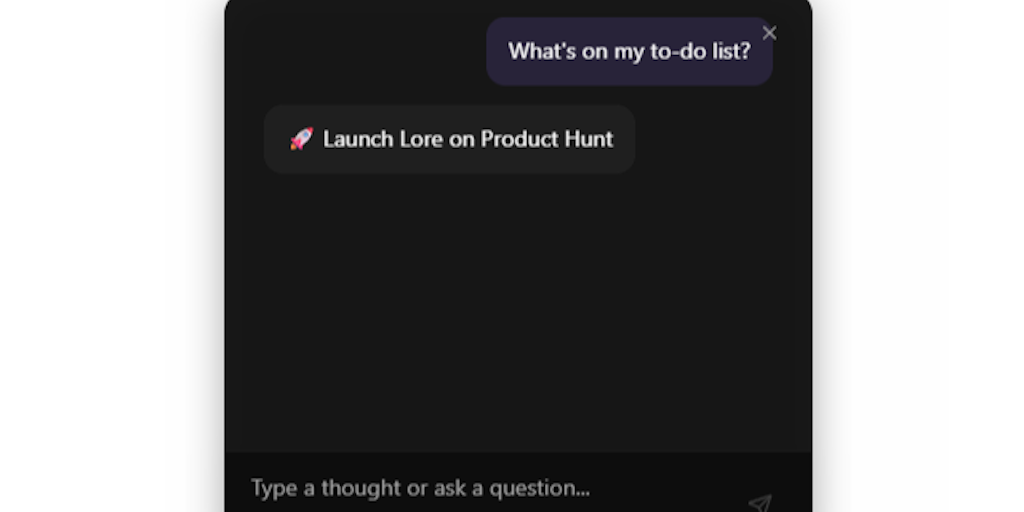
Foto: Product Hunt AI
Lore is a new note-taking tool that works directly on your computer without sending data to the cloud. The application, launched with a keyboard shortcut from the taskbar, allows you to quickly save ideas, notes and tasks. Its main advantage is complete privacy — all data is stored locally on the device, with no API keys or tracking. Lore uses artificial intelligence (Ollama and LanceDB) working offline, which enables asking questions in natural language and instant searching through note history. The project is completely open-source and free. The solution addresses a growing trend of user awareness regarding data privacy — particularly relevant in the context of competing cloud-based tools. For people working with sensitive information or preferring full control over their data, Lore is a practical alternative. However, the lack of cloud synchronization means that notes will remain on only one device.
When did you last save something important and then couldn't find it? Or did you have a flash of genius at three in the morning, but couldn't remember the details in the morning? Lore is a tool that comes to mind for those who work with information every day — writers, programmers, researchers, everyone who lives in the battlefield of notes and fragmented knowledge. The difference is that instead of yet another queue of note-taking apps that need to be synced in the cloud and worry about privacy, Lore proposes something radically simpler: an app that sits in the system tray, waits for your command, and stores everything locally on your computer.
The project, which recently debuted on Product Hunt, is a response to growing cloud fatigue and centralization. At a time when every app wants to send your data to servers and algorithms track every click, Lore goes against the current. Completely private, completely open (open-source), completely free — and most importantly, completely offline. There's no API, no tracking, no negotiating with terms of service. It's simply memory that you own.
But what exactly is Lore and why should you care? The answer is more complicated than it might seem, because Lore is not just a notepad. It's a system that combines the concept of a "second brain" with modern artificial intelligence, but does it in a way that no server ever sees your secrets.
Read also


Memory that you control completely
The fundamental promise of Lore sounds simple: 100% privacy. But this is not an empty marketing promise — it's an architectural choice that changes everything. When you open Lore, the app doesn't connect to any server. It doesn't send telemetry. It doesn't wait for a response from the cloud. Everything you do — every note, every question, every searched thought — stays on your computer, in a file you can physically touch.
This matters because modern note-taking apps work on the principle: write something, send it to a server, the server stores it, the server analyzes it, the server sometimes "improves" your data using algorithms. Evernote, OneNote, Notion — they all offer amazing functionality, but at a price: your memory lives in their systems. Lore rejects this model completely. Instead, the architecture is based on Ollama — a local engine for running large language models on your computer — and LanceDB, a vector database that also works locally.
What does this mean practically? It means that when you ask Lore "what did I write about project X three months ago?", the app doesn't send your question to OpenAI or Anthropic servers. Instead, a local AI model analyzes your question directly on your device, searches the database on your disk, and returns results. Everything happens in the background, without any involvement from an external party. This is a fundamentally different approach than what the major market players offer.
A second brain that actually works offline
The concept of a "second brain" became popular a few years ago, particularly thanks to the Zettelkasten method and tools like Obsidian and Roam Research. The idea is this: don't remember everything — write it down, organize it, and then search it. But even these tools, which are more advanced than traditional notepads, have limitations. They require manual organization, tagging, linking notes. This can be powerful for people who like structure, but for most of us it's extra work.
Lore approaches the problem differently. Instead of forcing you to build structure, it lets you just write and ask. All notes go into one database, and artificial intelligence does all the organizational work for you. You ask it in natural language — "what did I do at the meeting with client X?" — and it finds the answer. This is Retrieval-Augmented Generation (RAG) — a technique that combines search with text generation — but done in a way that no server ever sees your data.
The technology behind this is interesting. LanceDB is a vector database that stores semantic representations of your notes. When you write something, Lore converts it to a vector — a mathematical representation of meaning — and stores it locally. When you later ask a question, the app converts the question to a vector and searches for similar vectors in the database. This allows for semantic search — searching not just for keywords, but for actual meaning.
Architecture that you can analyze yourself
The fact that Lore is open-source is not a marginal detail. It changes the entire dynamic of trust. Instead of trusting the creators at their word that the app is private, you can download the source code, review it, and check for yourself what the app does. If you're a programmer, you can even modify the code to add your own features or remove something you don't like.
In an ecosystem where most AI tools are black boxes controlled by large corporations, this is refreshing. You don't have to be paranoid to want to know exactly what an app does that you're allowing to store your thoughts. Open-source is not a guarantee that code is safe (bad things can be hidden even in code that everyone can see), but it's a starting point for transparency. The community can review the code, find problems, propose fixes.
Moreover, open-source means that Lore is not dependent on the business model of one company. If the creators give up, the project can live on. If they add features you don't like, the community can fork the project and create its own version. This is security that traditional apps don't offer.
Practical implementation: how it actually works
Installing Lore is a matter of downloading the app and running it. The app appears in the system tray — that bar at the top of the screen (or bottom, depending on the operating system) — and waits. When you want to take a note, press a keyboard shortcut (by default something like Ctrl+Shift+L), and a note window appears. You type what comes to mind, press Enter, and you're done. The note goes into the database.
Search works similarly. Press the same shortcut, but instead of writing a note, you ask a question. The app returns results — notes that are semantically similar to your question. This could be something simple, like "what did I do yesterday?" or something more complex, like "what were the main points from the recent discussions about marketing strategy?"
The interface is minimalist — this is a deliberate choice. There are no colorful buttons, complicated menus, or artificial intelligences trying to be more than they are. Lore knows what it is: a tool. A tool for capturing and searching thoughts. Everything else is unnecessary.
System requirements are reasonable. Lore requires Ollama, which requires a few gigabytes of RAM and disk space (depending on which AI model you want to run locally). For most modern computers this is not a problem. You can choose a smaller AI model if you have older hardware, or a larger model if you want better results.
Comparison with competition: where Lore stands
The market for note-taking and knowledge management apps is a battlefield. Notion is versatile, but sends your data to servers. Obsidian stores notes locally, but has no built-in AI. Roam Research offers advanced linking, but again — cloud. Microsoft OneNote is integrated with the Microsoft ecosystem, but that means your data lives with Microsoft.
Where does Lore stand? Somewhere between Obsidian and Notion, but with a more radical approach to privacy. Obsidian is local, but has no AI. Lore has AI, and is local. The concept is this: take the best features of Obsidian (privacy, locality), add AI (what Notion does, but in the cloud), and make it completely free and open-source.
Of course, Lore also has limitations. Obsidian has a larger community, more plugins, a more mature ecosystem. Notion is more universal — you can build databases, calendars, projects. Lore is more specialized — it's a tool for notes and search, nothing more. But for many people, this specialization is an advantage, not a disadvantage.
Practical issues: what might be a problem
No tool is perfect, and Lore has real limitations worth understanding. First, the requirement to run Ollama locally means you need a sufficiently powerful computer. If you're working on a laptop with 4 GB of RAM, this could be problematic. The AI model must be loaded into RAM to work, and this can slow down the rest of the system.
Second, the quality of results depends on the AI model you choose. Lore uses Ollama, which has access to open-source models like Llama, Mistral, or Phi. These are good models, but they're not at the level of GPT-4 or Claude 3 Opus. If you're used to the performance of modern cloud models, local models may seem slower and less accurate.
Third, synchronization between devices. If you work on a desktop, laptop, and phone, Lore doesn't automatically sync notes between them. This is a result of an architectural choice — complete locality means no cloud — but it can be frustrating for people who are used to having their data everywhere.
Fourth, the question of support and development. Lore is a new project, launched recently. There's no large community, no rich ecosystem of plugins, no years of experience supporting millions of users. If something goes wrong, support may be limited.
Implications for the Polish market and users
In Poland, awareness of internet privacy is growing, but many people still use Notion, Evernote, or Microsoft 365 without thinking. Lore appears at a time when GDPR has become a reality and people are starting to ask exactly where their data is going. This is especially important for professionals — lawyers, doctors, consultants — who work with sensitive information.
Additionally, the fact that Lore is open-source and free matters in Poland, where software budgets are often limited. For startups, freelancers, and small businesses, a tool that costs zero zloty and offers full control over data can be a game changer.
However, one must be realistic. The Polish tech community is small compared to the international one. Support for Lore will first be in English. Documentation, forums, community — all of it will be based on English. This is not an obstacle for programmers, but it can be for ordinary users.
The future of Lore in the context of industry trends
Lore appears at a time when several trends converge. First, AI models are becoming smaller and more efficient. Ollama is a project that makes running large models on local hardware practical. Second, people are starting to worry about privacy — this is no longer conspiracy theory, it's business reality. Third, open-source is becoming increasingly mainstream, especially in AI.
If Lore develops, it could become a model for other tools. It shows that you can build intelligent applications without sending data to servers. This is a challenge for tech giants who profit from analyzing user data. But it's also an opportunity for startups and open-source projects that can offer a better alternative.
However, Lore's success is not guaranteed. It must compete with Obsidian, which already has a large community, with Notion, which is more universal, and with traditional note-taking, which is everywhere. It must also maintain a balance between simplicity and functionality. If it becomes too complicated, it will lose its main advantage — minimalism. If it remains too simple, people will look for something more.
More from Tech


Related Articles

After court loss, RFK Jr. gives himself more power over CDC vaccine panel
Apr 6
Steven Spielberg Still Wants to Make a Horror Film ‘Someday’
Apr 6New Jersey has no right to ban Kalshi's prediction market, US appeals court rules
Apr 6