NASA is blowing stuff up to study the explosive potential of methalox rockets
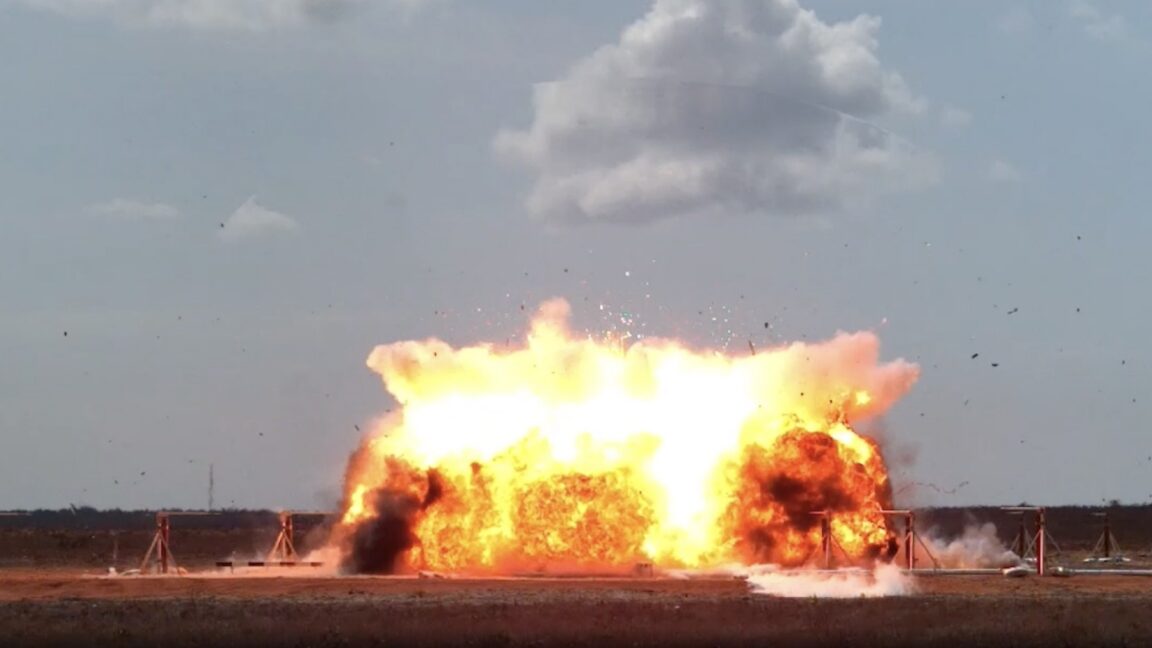
Reliance Test & Technology/Craig W. Hewitt
NASA and US Space Force are conducting a series of controlled rocket explosions fueled by methane and liquid oxygen to better understand the hazards associated with potential failures of these modern engines. SpaceX and Blue Origin have developed the most powerful methalox engines — Raptor and BE-4 — generating over half a million pounds of thrust, powering Starship and competitors' new rockets. Methalox engines have significant advantages: they leave less residue than kerosene fuel, are easier to handle than liquid hydrogen, and operate at higher temperatures. However, as flights become more routine — companies plan multiple daily launches from pads just 1-2 miles apart — federal agencies must precisely define safety zones around launch platforms. Explosive tests aim to optimize hazard analyses and reduce the size of evacuated areas without compromising safety. Methalox platforms are already operating at Kennedy Space Center, Cape Canaveral, Vandenberg, and NASA Wallops, with SpaceX testing Starship on private terrain in Texas. Precise data from controlled detonations will be crucial for accelerating the commercialization of space flights.
When a rocket explodes on a launch pad, it's not just about the spectacular view. It's about how far the fragments scatter, how powerful the shock wave is, and whether employees standing half a mile away will survive their next day at work. That's exactly why NASA and the U.S. Air Force regularly blow up full fuel tanks at Eglin Air Force Base in Florida. Since January of this year, scientists and engineers have been turning desert terrain into blast zones, measuring every decibel, every piece of flying metal, and every heat wave. All to understand how dangerous new rockets powered by methane and liquid oxygen can be — fuel that SpaceX, Blue Origin, and other companies have chosen for their most ambitious projects.
This is not a routine safety procedure. This is a pivotal moment in the history of spaceflight, when the industry is switching to an entirely new fuel, and regulators are discovering that they practically know nothing about how dangerous explosions of this fuel can be. For sixty years, rockets have flown on kerosene, hydrogen, and solid fuel — all well-researched, all with safety guidelines written in black and white. Now methane arrives with its stunning ability to detonate, and everyone — from SpaceX to federal officials — must learn from scratch.
The fuel revolution no one planned
The shift toward methane as rocket fuel was not the result of deep scientific research or a long-term plan. About fifteen years ago, several companies began experimenting with methane as an alternative to traditional fuels, and it turned out to make quite a lot of sense. SpaceX and Blue Origin built the Raptor and BE-4 engines, each capable of generating over half a million pounds of thrust — these are the largest methane engines in the world and are installed on the most powerful rockets ever built.
Read also


Why methane? There are several reasons, each one sound from an engineering perspective. First, methane leaves less residue — that means engines can be reused many times without needing thorough cleaning. SpaceX uses kerosene on its Falcon 9, which leaves much more dirty residue. Second, methane is much easier to handle than hydrogen, which tends to leak and must be stored at temperatures near absolute zero — specifically minus 423 degrees Fahrenheit. Methane, though also a cryogenic liquid, has a more manageable storage temperature, between minus 260 and minus 297 degrees Fahrenheit. This may not sound like a big difference to an ordinary person, but for rocket engineers it means easier and cheaper cooling systems.
The result? SpaceX's Starship contains 39 Raptor engines, and Blue Origin's New Glenn and United Launch Alliance's Vulcan use BE-4 engines. China's rocket became the first methane rocket to reach orbit in 2023. Now Rocket Lab, Stoke Space, and Relativity Space are also developing methane engines for their new rockets. The industry has shifted toward methane almost unanimously, and no one really stopped to ask: "What if something goes wrong?"
The problem no one wanted to see
The answer came faster than expected. The U.S. Air Force and NASA, which are responsible for safety at federal spaceports, realized they have no idea how dangerous an explosion of a methane-powered rocket is compared to traditional fuels. This might sound like a technical detail, but it's actually a matter of life and death for workers on launch pads and potentially for people living near spaceports.
The problem becomes more urgent when you realize that launch pads for methane rockets are now just 1-2 miles apart. Kennedy Space Center and Cape Canaveral Space Force Station in Florida, Vandenberg Space Force Base in California, and NASA Wallops Flight Facility in Virginia — all are preparing to handle methane rockets. SpaceX is already launching Starship from private terrain in Texas, but everywhere else launch pads are close together, sometimes alarmingly close. If regulators are too cautious and establish huge "hazard zones" around each pad, companies won't be able to launch simultaneously from neighboring pads. If they're too liberal, they could endanger people's safety.
As Colonel Brian Chatman, commander of Eastern Range at Cape Canaveral Space Force Station, explained: "We simply don't have analyses that would allow us to say, from a testing perspective, how small we can make the hazard zone and remain safe?" This is a diplomatic way of saying: "We have no idea what we're doing".
Blowing things up for science
Hence NASA's idea for solving the problem: instead of waiting for the first preventable catastrophe, they decided to systematically blow up fuel tanks in the air and measure every aspect of the explosion. Jason Hopper, deputy project manager for methane assessment at NASA Stennis Space Center, put it simply: "We put fuel in a rocket, blow it up in a remote location, and measure how big the explosion is".
Sounds simple, but executing it is anything but simple. Tests began in January with two reference explosions using C-4 — a material with well-known detonation characteristics. In February, they added methane and liquid oxygen, conducting four tests with unmixed fuels. The next step was to mix the fuels under conditions more similar to an actual rocket failure scenario, first on test articles weighing 2,000 pounds, then scaling up to 20,000 pounds. Engineers will examine two failure scenarios — transfer line damage and damage to the common wall between fuel tanks.
Instruments deployed at the test site measure the intensity of the shock wave at specified distances. High-speed cameras record how fast and where fragments travel after the explosion. Thermal imaging measures the thermal power of the explosion. This is all data that engineers will extrapolate to estimate the explosive potential of a massive rocket like Starship, which contains over 10.8 million pounds of fuel at launch. Imagine: tests on 2,000 pounds of fuel to understand what will happen when 10.8 million pounds detonate.
Methane versus TNT — the battle over numbers
This is where the real political and engineering game begins. Federal regulators, playing it safe, decided to treat every methane rocket as if it contained fuel equivalent to TNT at "100 percent" — that means if a rocket contains a million pounds of fuel, they treat it as if it were a million pounds of TNT. This leads to very large hazard zones around launch pads, sometimes so large they can interfere with operations at neighboring pads.
But here's the catch: methane and liquid oxygen are highly miscible, meaning they mix easily. When they mix, they can enter something called "condensed-phase detonation" — that sounds like scientific jargon, but it means the explosion is much more powerful than traditional TNT explosions. Small samples of the mixture of liquid oxygen and liquefied natural gas showed "wide detonation ranges with efficiencies greater than TNT," as NASA wrote in 2023. That means regulators have reason to be cautious.
However, SpaceX and other industry companies argue that the government is overreacting. SpaceX conducted its own methane detonation tests and argues that the government relies on "highly conservative approaches" simply because it "lacks data to develop refined, accurate safety zones". The Commercial Space Federation, a lobbying group whose members include SpaceX, Blue Origin, and other companies with methane rockets, argued that the government should set TNT equivalency at no more than 25 percent — a change that would drastically reduce hazard zones. The Federation even suggested to Congress that the government should use "existing industry data" instead of spending millions on an independent testing campaign.
NASA, the Air Force, and the FAA decided otherwise. They decided to conduct their own tests, regardless of what companies say. The tests are scheduled to conclude in June, and the results will "shape spaceport planning, safety protocols, and safety requirements for years to come" — at least that's what NASA says.
The game waiting for results
Now everyone is waiting. Companies want smaller hazard zones so they can launch more frequently and with greater flexibility. Regulators want data so they can justify every decision. Workers on launch pads want to be safe. This is a triangular game where no one can win completely, but everyone can lose if the data is misinterpreted.
It's worth noting that NASA's tests are not a pure academic exercise. The results will have a direct impact on how quickly SpaceX can launch Starship, how many rockets Blue Origin can send into space, and whether many new companies entering the methane rocket industry can operate profitably at all. If regulators maintain 100 percent TNT equivalency, hazard zones will be so large they could make many launch pads practically useless for simultaneous operations. If they go down to 25 percent, as the industry suggests, operations could be much denser.
Colonel Chatman said in November that preliminary studies suggest the required hazard zone will be smaller, but "no one will know how much until test results are available". This is royal skepticism — regulators know the industry will push for smaller zones, but they won't make decisions without hard data.
The coming boom in rocket launches
This entire game is playing out against the backdrop of a rapidly changing spaceflight landscape. Companies are talking about multiple launches per day from the same ports. SpaceX has ambitions for Starship to launch several times daily in the future. Blue Origin is developing New Glenn for competition. Relativity Space is experimenting with 3D-printed rockets. Rocket Lab is transitioning to methane for its larger Neutron rockets. The entire ecosystem is shifting toward this fuel because it makes economic and technical sense.
But all of this is based on the assumption that regulators will be able to quickly establish safe boundaries. If NASA's tests show that methane is much more dangerous than thought, they could change the entire trajectory of the industry. If they show that the industry is right and 25 percent TNT equivalency is appropriate, regulators will need to quickly adapt to the new reality. In either case, the next six months will be crucial.
Jason Hopper from NASA said something that should be sobering for anyone following the space industry: "This kind of testing comes around once every few decades. With so many rocket launches now, this will contribute to public safety, site safety, and all the risks associated with operations". This is not an exaggeration. This is the reality of a new era in spaceflight, where safety must be built on data, and data must come from blowing things up in the air and observing what happens. NASA is doing exactly what it should be doing — gathering information before it's too late. The question is whether the industry will be patient enough to wait for the answers.
More from Tech




Related Articles
After court loss, RFK Jr. gives himself more power over CDC vaccine panel
Apr 6
Steven Spielberg Still Wants to Make a Horror Film ‘Someday’
Apr 6New Jersey has no right to ban Kalshi's prediction market, US appeals court rules
Apr 6