Scheduled
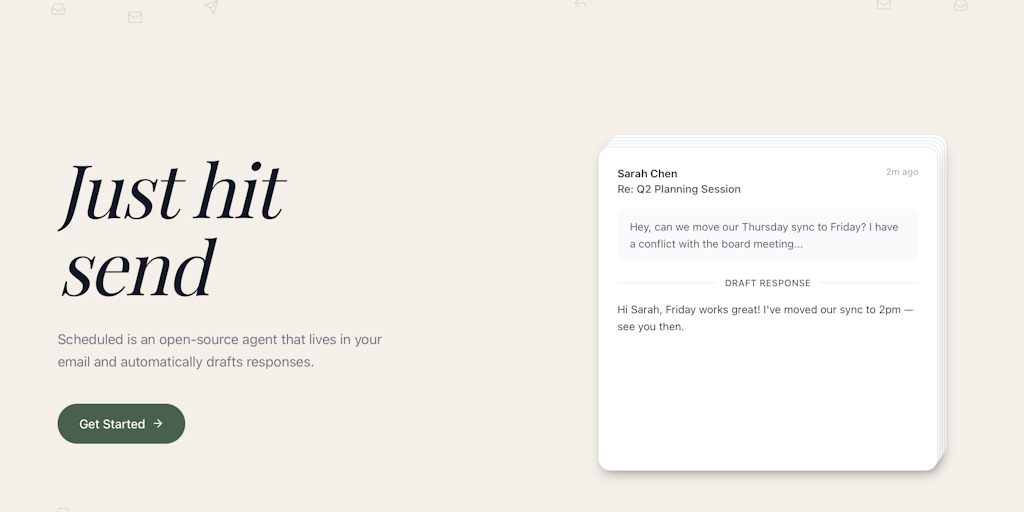
Foto: Product Hunt AI
Scheduled is an open source tool that has just landed on Product Hunt. It's an AI agent integrated directly with Gmail, automating the entire meeting scheduling procedure. The program reads email messages, analyzes your calendar, and independently drafts responses — all without your involvement. No more exhausting email exchanges in the style of "how about Thursday at 3 PM?". Instead, artificial intelligence negotiates dates and proposes solutions that actually fit both parties' schedules. The tool is available for free, which is a significant advantage over paid competitors. For office workers who spend hours organizing meetings, this is a potential game changer. The fact that Scheduled is open source also means the developer community can modify the code. Practically speaking, users can reclaim several hours per week that usually go into correspondence related to booking appointments. This solution addresses the pain points of anyone who regularly needs to coordinate meetings with multiple people simultaneously.
Scheduled is precisely a new player in the field of calendar automation that promises to solve one of the biggest problems of the modern office: chaotic meeting scheduling. This is not an ordinary calendar assistant — it is an open-source AI agent that lives directly in Gmail and does something that seemed impossible just a year ago: completely autonomously handles the meeting planning process without human involvement.
Imagine a situation you probably know all too well. You receive an email from a client asking about availability for a meeting. Instead of responding immediately, you have to open your calendar, check when you have a free slot, send a proposal, wait for a response, negotiate the time, and then finally add the meeting to your calendar. The entire process takes on average a few minutes and several email exchanges. Scheduled changes this dynamic dramatically — AI reads incoming emails, analyzes your calendar in real time, finds optimal slots and sends an already formatted response. End of email ping-pong games.
What, however, distinguishes Scheduled from existing solutions such as Calendly or even built-in features in Outlook? The fact that it is open source. This changes everything — you are not locked into one vendor's ecosystem, you can customize the code to your needs, and most importantly, you can know exactly what it does with your data.
Read also


How exactly does this AI assistant work?
The mechanics of Scheduled are surprisingly simple, although the implementation is advanced. An AI agent connected to your Gmail account continuously monitors incoming messages looking for meeting scheduling requests. When it detects such a request, it immediately connects to your calendar — whether Google Calendar or another system — and scans available time slots.
But that's not all. AI doesn't simply look for the first available slot — it analyzes the context of the email, the recipient's preferred time zone, the length of the meeting (which often has to be inferred from context), and the type of meeting. Is it a quick 15-minute conversation or an hour-long strategic meeting? Scheduled tries to understand this. It then drafts a response in natural language that you can review before sending, or allow AI to send it automatically.
A key feature is direct integration with Gmail. You don't have to open a separate application, you don't have to switch between tools — everything happens where you already spend half your workday. This is a zero interface — a tool that disappears in the background and simply works.
The technology behind this uses large language models (LLM) for natural language processing, but Scheduled does not disclose which exact models it uses. Given that this is a startup, it most likely uses OpenAI's API or a similar provider, but the fact that the code is open means the community will be able to verify this and potentially switch to its own local models.
Open source in the world of AI — why it really matters
Scheduled's decision to release its code under open source terms at a time when most AI startups keep their algorithms under lock and key is noteworthy. This is not a marketing move — it is a fundamental difference in approach to security and privacy.
When you use Calendly or other closed tools, you must trust that the vendor does not store your data longer than necessary, that it does not analyze your time preferences for ad targeting, that it does not sell information about your schedule. With open source you can verify this yourself. You can review the code, see what data is collected, where it goes and how long it is stored.
For Polish users, this has particular significance. Many AI tools store data on servers in the USA, which raises questions about GDPR compliance. Scheduled, being open source, allows companies and individual users to self-host — run the entire system on their own servers, in Poland, under full control. This is a solution for those who take data privacy seriously.
However, there is a catch. Open source also means that security responsibility falls partly on the user. You need to be able to maintain the system, update dependencies, monitor security vulnerabilities. For large organizations this is not a problem — they have DevOps teams. For small businesses or freelancers this can be an obstacle.
Competition in the calendar automation field — where does Scheduled stand?
The market for meeting scheduling assistants is not empty. Calendly has dominated for years, but it is primarily a tool for sharing availability — it does not automate responding to emails. Fantastical is more advanced, but focuses on user interface. x.ai (now Amy Ingram) is actually a competitor — an AI assistant that handles email meeting negotiations.
The difference is that x.ai is a closed system, available through paid subscription. Scheduled offers a free open source model plus a cloud hosting option. This changes the economics of the entire transaction. A small freelancer or startup can implement Scheduled for free and without a subscription.
What does Scheduled still need to prove? Reliability in complex scenarios. What happens when you have a time conflict? When a meeting requires special preparation or has prerequisites? When the other party writes unconventionally or jokingly? AI must be smart enough to recognize these situations and escalate them to a human instead of sending an incorrect response.
Gmail integration — genius or limitation?
The fact that Scheduled lives in Gmail is both its greatest advantage and a potential limitation. An advantage, because Gmail is everywhere — a corporate employee works in Gmail, a freelancer, an entrepreneur. You don't have to install anything, you don't have to learn a new interface. You open an email and the assistant is already there.
A limitation, on the other hand, is that if you work in Microsoft Outlook or another email client, Scheduled won't work. In Poland, many large corporate companies use Outlook, so this could be a barrier to adoption. Of course, since the code is open, theoretically someone could create a version for Outlook, but until that happens, it is a limitation.
Gmail integration also requires access to your account — specifically the ability to read emails and access your calendar. This is a sensitive security issue. Scheduled must request broad OAuth permissions. Here again the advantage of open source appears — you can see exactly what permissions are requested and why.
Practical applications — who will benefit from Scheduled?
Let's start with people who will love Scheduled. Consultants, agencies, business advisors — anyone who spends 30% of their time scheduling meetings. For them, this will be a game changer. Imagine a consultant who instead of responding to every email asking about availability, lets AI do it automatically. Time savings is tens of minutes a day, which adds up to weeks a year.
The second application is sales and customer success teams. Every email from a potential client asking about a demo or meeting can be handled by Scheduled. Quick response, automatically added to calendar, without delays. This can significantly improve conversion rate — people like when they can immediately book a meeting.
The third application is education. Professors and teachers who have student office hours can let Scheduled handle reservations. Instead of students sending emails asking about availability, the system automatically assigns them slots.
But there are also industries where Scheduled will be less useful. If you work in an environment where every meeting requires human judgment, negotiation, or is part of a complex sales process, AI may be too primitive. Scheduled is great for routine bookings, but not for complicated scenarios.
Security, privacy and regulatory concerns
Let me be honest — any tool that has access to your email is a security threat. Even open source, even with the best intentions. The code may be secure, but what about the APIs that the code uses? What about the servers where data might be stored?
Scheduled, as open source, has an advantage here — the community will review the code, look for vulnerabilities, report issues. This is security through transparency. But it requires the community to actually do this. If no one reviews the code, openness doesn't help.
The GDPR issue is crucial for Polish users. If Scheduled stores data on servers in the USA, even if the code is open, there may be legal problems. The solution is self-hosting — running Scheduled on your own servers in Poland. But this requires technical resources that not everyone has.
Another problem is AI hallucinations. What if AI misinterprets an email and suggests a meeting at completely the wrong time? Scheduled has a built-in review system here — the response is a draft that you can review. But if you allow AI to send emails automatically without review, the risk increases.
The future of calendar automation — where is the industry heading?
Scheduled is interesting not because it invented something new, but because it shows the direction the industry is heading. AI assistants will be increasingly embedded in the tools we already use. They won't be separate applications, but native features in Gmail, Outlook, Slack.
The second trend is open source vs. closed source. Startups are beginning to understand that in the age of AI, security and privacy are a competitive advantage. Open code can attract users who are tired of closed systems from large corporations.
The third trend is integration with multiple platforms. Scheduled must expand beyond Gmail. Outlook, Apple Mail, and even CRM systems like Salesforce or HubSpot. A tool that only works with Gmail has limited market potential.
Realistically speaking, Scheduled has a chance to become a standard for small and medium-sized businesses looking for an alternative to expensive, closed systems. But it must quickly demonstrate reliability, expand platform support and build a community of developers who will actively develop the project. If this succeeds, it could be one of those rare moments when open source actually changes the way we work.
More from Tech


Related Articles

After court loss, RFK Jr. gives himself more power over CDC vaccine panel
Apr 6
Steven Spielberg Still Wants to Make a Horror Film ‘Someday’
Apr 6New Jersey has no right to ban Kalshi's prediction market, US appeals court rules
Apr 6