Explanation for why we don't see two-foot-long dragonflies anymore fails
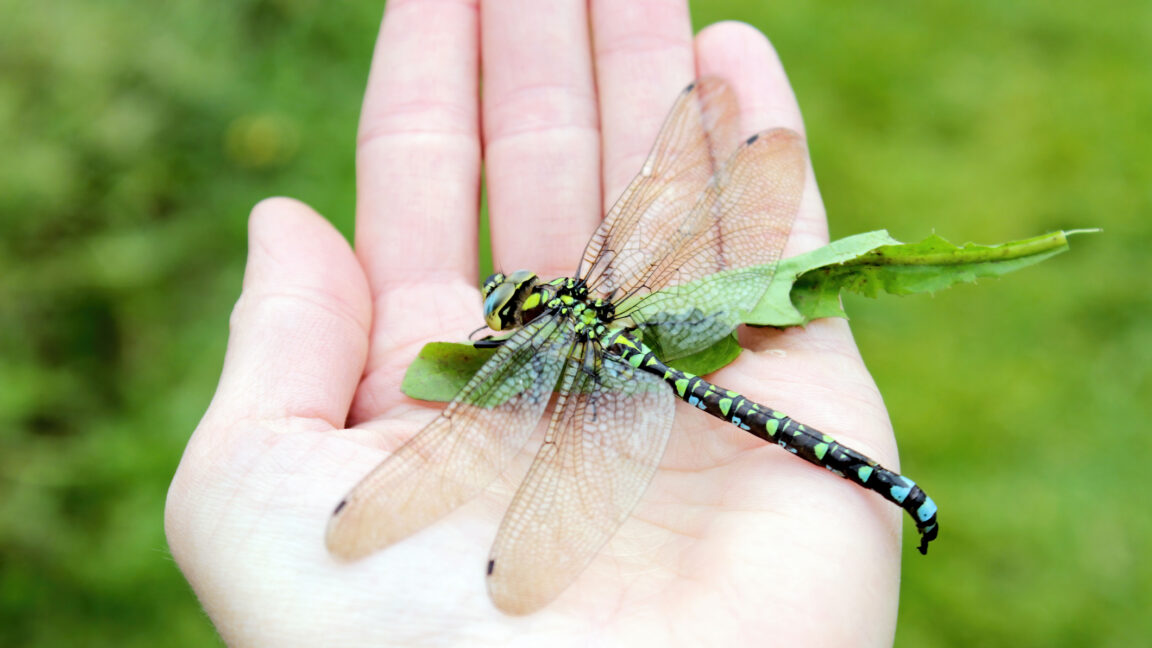
Foto: VitaSerendipity
A seventy-centimeter wingspan and a mass of 100 grams – these were the parameters of *Meganeuropsis permiana*, a giant dragonfly-like insect from 300 million years ago. For the past three decades, science has explained the existence of these colossi through the oxygen constraint hypothesis, which posits that the drop in atmospheric oxygen levels from 30% to the current 21% prevented insects from reaching large sizes due to an inefficient tracheal system. However, the latest research by Professor Edward Snelling's team, published in the journal *Nature*, refutes this elegant theory, proving that the cause of insect dwarfing lies elsewhere entirely. Researchers analyzed 44 species of modern insects with vastly different masses – from microscopic ones to the massive *Goliathus albosignatus* beetles. Using a transmission electron microscope, they took over 1,300 images of flight muscles to measure the volume density of tracheoles. It turned out that the oxygen delivery system in large insects does not fill their bodies to capacity at all, meaning that physiology does not constitute a barrier to gigantism. For users and creators of biomimetic technologies, this is a signal that evolutionary size constraints may stem from external factors, such as the emergence of predatory birds or thermal changes, rather than flaws in the "design" of the respiratory system. This discovery redefines our understanding of the limits of biological efficiency and opens a new chapter in research on the evolution of Earth's fauna.
The myth of the inefficient tracheal system
The key to understanding the problem is the way insects deliver oxygen to their muscles. Unlike mammals, they do not possess lungs or a closed circulatory system for transporting oxygen. Instead, they rely on a system of tracheae that begin with openings in the exoskeleton (spiracles) and branch into increasingly thinner tubes, down to microscopic **tracheoles**. It is in these thinnest endings that oxygen must cross the final barrier via passive diffusion, which is a slow process.
The anatomical reserve of giants
To finally debunk the oxygen hypothesis, the researchers extrapolated their results to the prehistoric giant **Meganeuropsis permiana**. Their calculations show that at a mass of 100 grams, the tracheoles of this insect would occupy only about **1%** of the flight muscle volume. Even assuming the most pessimistic statistical variants, this value would not exceed 3%. For comparison, blood capillaries in birds and mammals occupy about 10% of the volume of heart and muscle tissues.
Predator pressure and thermal barriers
If oxygen is not the barrier, science must look for answers in ecology and body mechanics. One of the most compelling theories is the emergence of **aerial vertebrates**. About 135 million years ago, fossil data shows a clear decoupling of maximum insect wing size from atmospheric oxygen levels. This coincides with the evolution of birds, and later bats. Large, heavy insects, slow to gain speed, became ideal, high-energy targets for agile predators. Being a giant simply stopped paying off. Another factor may be overheating of the organism. Flying generates enormous amounts of heat. As body size increases, the surface-area-to-volume ratio decreases, making cooling more difficult. An insect the size of a hawk could literally cook from the inside during intense wing flapping. In the Paleozoic, a denser atmosphere might have favored better heat dissipation, which was crucial for the survival of giants. One also cannot overlook the difficulties associated with molting. Insects must regularly shed their hard exoskeleton to grow. For a short time after shedding the old shell, their bodies are soft and prone to deformation. While surface tension allows a small beetle to maintain its structure, gravity could crush the soft body of a giant invertebrate before its new armor has time to harden.New horizons in physiological research
Although Snelling's team demonstrated a huge reserve of space in the tracheole system, the researchers admit they have not yet checked the "upper part" of the respiratory system – the large air sacs that act like bellows, pumping air into the body. Investigating the evolution of these structures using advanced X-ray technology (synchrotron) is to be the next step in understanding the limits of insect growth. However, it seems unlikely that air sacs will bring the oxygen limitation hypothesis back into favor. As Snelling notes, any limitations in the upper part of the system can be easily compensated for by investing in a denser network of tracheoles, for which insects have plenty of room. This discovery redefines our view of invertebrate evolution and suggests that nature is not limited by simple chemical parameters of the atmosphere, but by a complex interplay between predation, thermodynamics, and pure material strength. Giant dragonflies didn't disappear because they ran out of breath – they disappeared because the world became too dangerous and hot a place for them.More from Tech




Related Articles

After court loss, RFK Jr. gives himself more power over CDC vaccine panel
Apr 6
Steven Spielberg Still Wants to Make a Horror Film ‘Someday’
Apr 6New Jersey has no right to ban Kalshi's prediction market, US appeals court rules
Apr 6