A mission NASA might kill is still returning fascinating science from Jupiter
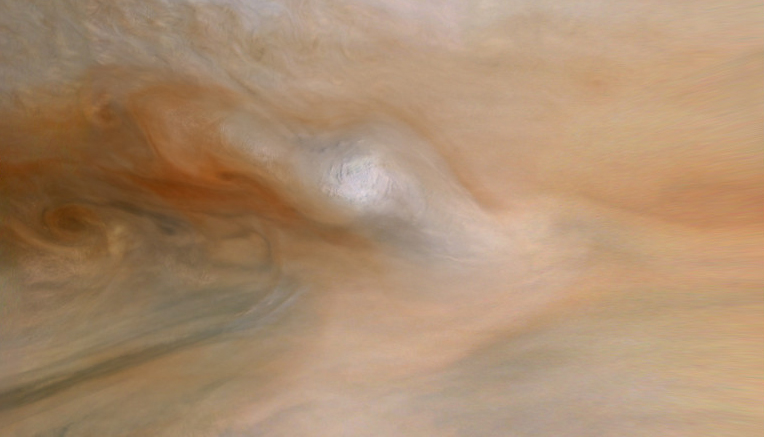
NASA/JPL-Caltech/SwRI/MSSS/Björn Jónsson © cc nc sa
Lightning on Jupiter generates discharges at least 100 times more powerful than those found on Earth, shedding new light on the extreme nature of the atmosphere of the Solar System's largest planet. Data published in the journal *AGU Advances* comes from the Juno spacecraft, which recorded a series of colossal storms between 2021 and 2022. Despite such spectacular discoveries, the future of the mission remains uncertain. Although NASA extended Juno's operations after the conclusion of its original five-year campaign, budget cuts in the planetary science division are calling the project's continued funding into question. Juno's situation is part of a broader crisis—nearly a year ago, leaders of over a dozen robotic missions were asked to prepare "closeout" plans, or procedures for decommissioning the spacecraft. While Congress rejected the most radical cuts, the budget for fiscal year 2026 is approximately $220 million lower than the previous year. For the global scientific community and the creative sector that draws from NASA's visualizations, this poses a risk of losing unique data from Jupiter's orbit. The practical implications are clear: limiting funds for missions such as Juno or the Lunar Reconnaissance Orbiter directly hinders the development of weather and geological models used to understand planetary mechanisms across the cosmos. The fate of the Juno probe will serve as the ultimate test of whether fascinating scientific discoveries can prevail over rigorous budgetary discipline.
Jupiter, the gas giant dominating our Solar System, has fascinated scientists for decades with its brutal atmosphere and untamed energy. The latest data sent back by the Juno probe sheds new light on the weather phenomena occurring on this planet, revealing a scale of atmospheric discharges that defies earthly comparisons. According to analyses published on March 20 in the journal AGU Advances, the lightning bolts tearing through Jupiter's clouds are at least 100 times more powerful than those we observe on Earth. This discovery is not just a meteorological curiosity, but a key piece of the puzzle in understanding energy transfer in planetary atmospheres on a gargantuan scale.
The Power of Jovian Discharges
Scientists reached these conclusions by analyzing data collected by Juno's instruments in 2021 and 2022. This was a period when the spacecraft was already operating as part of its extended mission, following the conclusion of its original five-year scientific campaign. Measurements indicate that colossal storms on Jupiter generate electromagnetic pulses with energy that would be considered catastrophic on our planet. These phenomena occur deep within dense cloud layers, where a mixture of water and ammonia creates ideal conditions for the accumulation of electrical charges with unimaginable potential.
Importantly, this data comes from instruments that were not originally designed for such long-term operation in Jupiter's extreme radiation environment. Despite this, Juno remains in good technical condition, providing precise readings from the polar regions and deep layers of the atmosphere that were previously inaccessible to us. Each flyby of the probe over the cloud tops is a unique opportunity to map the dynamics of the gas giant, which – as seen in the latest publications – can still surprise even the most experienced planetary scientists.
Read also



The Budget Axe Over Space Exploration
Despite these scientific successes, dark clouds have gathered over the Juno mission that have nothing to do with planetary physics. NASA is struggling with severe financial constraints, putting the future funding of the probe's operations into question. The situation became tense nearly a year ago when the government administration instructed mission leaders to prepare "closeout plans." In practice, this meant instructions for safely shutting down systems and ending data collection, even though the hardware itself is fully functional and capable of further operation.
The problem boils down to brutal budget mathematics. Although Congress rejected the most drastic cuts proposed by the White House, the final amount allocated to NASA's planetary science division for fiscal year 2026 is $2.54 billion. At first glance, this sum seems impressive; however, it is approximately $220 million lower than last year's funding. In the world of space missions, where the costs of maintaining ground personnel and communication infrastructure are fixed, such a deficit forces painful decisions about which projects to "kill" to keep others alive.
Survival in the Shadow of Austerity
A dozen other robotic missions find themselves in a similar situation to Juno. Some have already managed to secure approval to continue operations. An example is OSIRIS-APEX – a probe that, after delivering samples from the asteroid Bennu to Earth in 2023, is now using its remaining fuel to reach another object, the asteroid Apophis, in 2029. Similarly, the Lunar Reconnaissance Orbiter (LRO), NASA's only active orbiter circling the Moon, has received a funding guarantee for at least three more years. It is a crucial link in preparations for the crewed Artemis program missions, which likely saved it from the cuts.
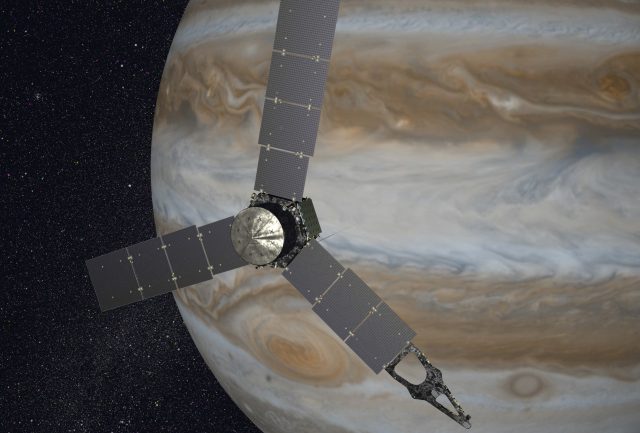
For Juno, the lack of a clear declaration from NASA officials is an alarming signal. This probe is currently our only "outpost" in the Jupiter system, providing data that cannot be replaced by telescopic observations from Earth's orbit. Abandoning the mission at a time when the spacecraft is functional and scientists are still discovering fundamental phenomena like giant atmospheric discharges seems like a waste of potential that has already been paid for with billions of dollars during the probe's construction and launch phases.
- Juno: Mission extended after 2021, currently in a state of budgetary uncertainty.
- OSIRIS-APEX: Continuing its flight toward the asteroid Apophis (reaching its target in 2029).
- Lunar Reconnaissance Orbiter: Funding secured for 3 years thanks to support from the lunar program.
- NASA 2026 Budget: $2.54 billion for planetary science – a $220 million decrease from the previous year.
The Paradox of Technological Success
The situation of the Juno probe highlights a broader problem in modern space exploration: the paradox of durability. We build machines so robust that they are capable of working decades past their warranty (the Voyager probes being the best example), but we cannot provide them with stable operational funding on Earth. The cost of maintaining an already active mission is a fraction of the amount needed to design and launch a new one; however, in the face of budget cuts, it is these "old but gold" projects that become the easiest targets for accountants.
Withdrawing further support for Juno would mean breaking the continuity of observations of our system's largest planet at a critical moment. Jupiter, with its extreme storms and complex magnetic field, serves as a natural laboratory for high-energy physics. Every subsequent orbit of the probe is a chance to understand how weather mechanisms work on gas giants, which directly translates to our interpretations of discoveries in exoplanetary systems. If the mission is terminated prematurely, we will lose the chance to fully understand the life cycle of Jupiter's storms, which – as just proven – possess power that we can only read about in theoretical physics textbooks on Earth.
Limiting funds for missions that are already at their destination and delivering breakthrough results is a short-sighted strategy. In an era of growing competition in the space sector and the planning of grand expeditions to Mars or the Moon, NASA risks losing unique competencies in studying the outer regions of the Solar System. Without Juno, Jupiter will once again become merely a distant, blurry dot in telescope lenses, and the mystery of its destructive lightning will remain untold.
More from Tech




Related Articles

After court loss, RFK Jr. gives himself more power over CDC vaccine panel
Apr 6
Steven Spielberg Still Wants to Make a Horror Film ‘Someday’
Apr 6New Jersey has no right to ban Kalshi's prediction market, US appeals court rules
Apr 6