Library in ChatGPT
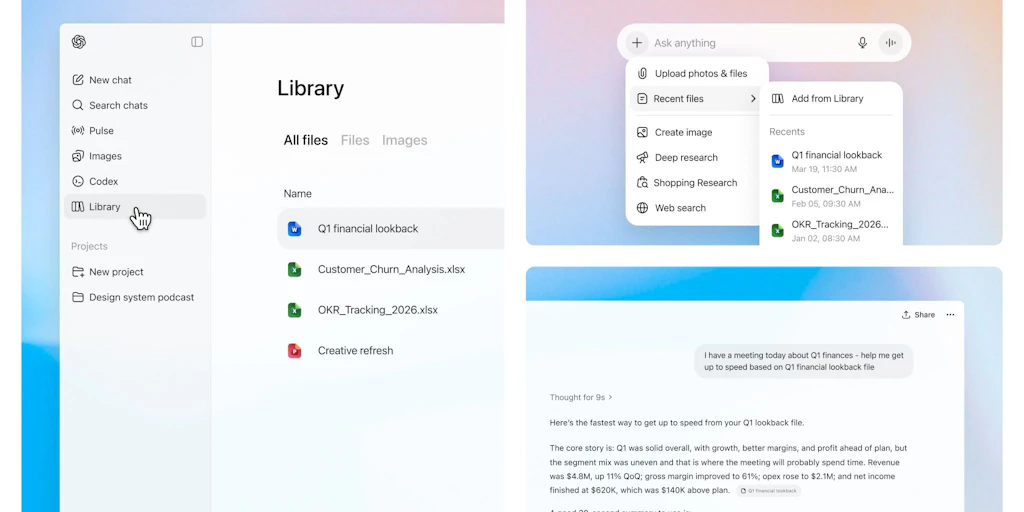
Foto: Product Hunt AI
OpenAI is introducing the Library feature, which fundamentally changes project management within ChatGPT, transforming a simple chat interface into an advanced command center. Users gain a dedicated space where they can collect, categorize, and instantly search through all their interactions, files, and created Custom GPTs. This marks the end of chaotic scrolling through the sidebar history in search of specific information from several weeks ago. For creative professionals and developers, this means a drastic increase in productivity. Library allows for the creation of structured project folders, facilitating work on multiple threads simultaneously without the risk of losing context. A practical convenience is also the unified access to attachments and generated images, bringing OpenAI's tool closer to functionalities known from knowledge management systems like Notion or Obsidian. The global rollout of this feature signals the evolution of AI from the role of an ad-hoc assistant toward a comprehensive operating system for intellectual work. Instead of one-off sessions, users are now building a lasting digital knowledge repository that grows with every subsequent query. This is a strategic step toward the full personalization of the generative artificial intelligence experience.
OpenAI is once again modifying the way we interact with generative artificial intelligence by introducing the Library feature in the ChatGPT interface. This seemingly minor navigation change is, in reality, the foundation for much deeper tool personalization and its transformation from a simple chat window into a comprehensive operating system for knowledge. In an industry where the battle for user retention is fought over every fraction of a second spent in the application, organizing resources becomes a higher priority than another update to model parameters.
The new Library section replaces the previously scattered menu elements, integrating conversation history, saved GPTs, and custom instructions into one place. OpenAI is moving away from the "fleeting conversation" model toward building a lasting knowledge base. For professional users who operate dozens of specialized agents, such consolidation marks the end of the chaos associated with switching between different views. It is a clear signal that ChatGPT wants to be a place where we not only generate content but, above all, manage it.

An end to sidebar chaos
For a long time, the ChatGPT sidebar was the platform's Achilles' heel. With the growing popularity of the GPT Store and the ability to create custom versions of the assistant, users were flooded with icons that were difficult to filter or group. The introduction of Library solves this problem by offering a unified view that allows quick access to the most frequently used tools without having to search through the entire history. This is an evolution toward an interface known from streaming platforms or game libraries, where the user has full control over their "ecosystem."
Read also


From a user experience (UX) design perspective, Library introduces the structure that has been missing since the release of GPT-4. The ability to pin specific projects or quickly preview recently used agents significantly shortens the "time-to-value." In the world of creative technology, where AI serves to support creative processes, every second saved on navigation translates into workflow fluidity. OpenAI perfectly understands that to maintain its leadership position, it must offer not only the smartest model but also the most ergonomic working environment.
It is worth noting how Library integrates with the Search function. Instead of separate entities, we receive a coherent archive where the boundary between "conversation" and "database" becomes blurred. Users can now treat their interactions with ChatGPT as a resource they return to regularly, rather than a one-off Q&A session. This strategic move is aimed at building greater platform loyalty – the more data and tools we accumulate in our library, the harder it will be to give up a subscription in favor of competitors like Claude or Gemini.
Personalization architecture and AI agents
The introduction of a dedicated library also prepares the ground for the upcoming era of autonomous agents. If Sam Altman's vision of assistants performing complex tasks is to come true, the user must have a command center for these processes. Library in its current form is a prototype of such a center. It allows not only for storing GPTs but will likely enable monitoring the status of tasks performed in the background by AI in the future. This is a transition from passive chat to active management of computational and intellectual resources.
- Centralized access: All custom models and saved chats in one clear view.
- Increased productivity: Reducing the time needed to find specific instructions or specialized agents.
- Better project organization: The ability to segregate interactions depending on the work context or interests.
- Intuitive interface: A design similar to modern SaaS applications, facilitating adaptation for new users.
Analyzing this move, the technical aspect cannot be overlooked. Library likely utilizes improved indexing mechanisms for user-generated content. This means that searching one's own resources within ChatGPT will become faster and more precise. For people using AI to analyze large sets of documents or write code, efficient navigation through historical data is crucial for maintaining project continuity.
A new standard in the AI tool ecosystem
OpenAI's move will force a reaction from the competition. Currently, most chatbots rely on a simple model of a chronologically arranged conversation list. Library breaks this pattern, suggesting that AI-generated content has lasting value. This approach brings ChatGPT closer to tools like Notion or Obsidian, where organizing information is just as important as creating it. The boundary between a text editor, a knowledge base, and an AI engine is becoming increasingly thin, which in the long run could lead to the cannibalization of the traditional office tools market.
"Creating a library is not just a visual change. It is a declaration that ChatGPT is ceasing to be just an interface for a language model and is becoming the user's personal repository of intelligence."
The business applications of this feature are obvious. Teams using ChatGPT Enterprise gain a tool for better resource sharing within the organization. The library can become a shared repository of proven prompts and dedicated solutions, which significantly facilitates the onboarding of new employees and the standardization of work with AI. OpenAI is consistently building an ecosystem that aims to be indispensable in daily corporate work, and data order is the first step toward broad adoption.
Ultimately, the success of Library will depend on how flexible this feature becomes. If OpenAI allows for creating folders, tagging, or advanced filtering, ChatGPT could become the most powerful knowledge management tool on the market. It is already clear that the direction is singular: maximum utility while maintaining a minimalist design. Users no longer just want to "talk" to a bot; they want to build lasting systems with it that evolve along with their needs.
The introduction of the Library feature is a turning point that ends the era of the "simple chat window." OpenAI proves that the key to dominance in the AI industry is no longer just the computing power of the GPT-5 model or its successors, but primarily the way this power is delivered to the user. Organizing digital chaos is the greatest challenge of our time, and ChatGPT has just provided us with a solid tool for it. We can expect that in the coming months, the library will be enriched with analytical functions, allowing for an even better understanding and utilization of the resources gathered within it.
More from Tech


Related Articles

After court loss, RFK Jr. gives himself more power over CDC vaccine panel
Apr 6
Steven Spielberg Still Wants to Make a Horror Film ‘Someday’
Apr 6New Jersey has no right to ban Kalshi's prediction market, US appeals court rules
Apr 6